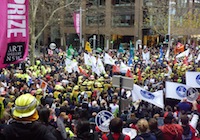
With the O’Farrell Coalition Government refusing to restore the rights of public sector workers in NSW, it’s time to step up the campaign.
FBEU members have already campaigned at community rallies, at meetings with MPs, and at meetings with local councils. The next step is the second major Macquarie Street rally to be held, bringing together public sector workers, their unions and community members on Thursday 8 September 2011.
FBEU members will assemble at 1130 hours outside St Mary’s Cathedral on College St. At 1200 hours we will move to the Domain to join other unions and from there along Macquarie Street, past NSW Parliament and concluding at Hyde Park.
This protest will follow a widely-predicted horror state budget that same week and is expected to be considerably larger than the first rally which saw 12,000 workers descend on Parliament House at short notice.
It is important that FBEU members join with other public sector workers and the broader community to resist this Government’s attacks on our wages, our conditions and (as hundreds of health and transport workers have already found out) our jobs.
This will be largest gathering public sector workers in many years, if not ever. Bring the family - Please print this out at your station, and spread the word via email.
More information in regard to on duty involvement will be distributed to firefighters via SITREP, the FBEU web site, and forum - stay tuned.
In Union,
DARIN SULLIVAN President FIRE BRIGADE EMPLOYEES' UNION 1-7 Belmore St | Surry Hills | NSW 2010 p. 02 9218 3444 | f. 02 9218 3488 | m. 0422436044
As own goals, it’s up there: just as the idea of another media inquiry had all but vanished from the political cycle, News Ltd — having campaigned hard against the idea of an inquiry — wrenches the spotlight back onto the whole issue of media standards with a spiteful attack on the Prime Minister, so over the top it required a hasty withdrawal.
John Hartigan insisting that there’s no need to bother checking facts used in an opinion piece (and calling the Prime Minister “pedantic” while doing so) merely reinforces the impression News Ltd has a very strange view about how to conduct national affairs coverage.
The problem for News Ltd isn’t that Glenn Milne’s piece was atypical, it’s that it’s entirely typical. It’s the result of a transition from “campaigning journalism” to partisan journalism, in which an entire editorial line, dominating opinion and reportage, is aimed at the removal of the political parties identified as the enemy — Labor and the Greens. In pursuing such a campaign, facts become entirely optional — it’s the editorial line that’s important, not facts or consistency.
Normally the facts ignored or misrepresented relate to policy — the campaign by The Australian and The Telegraph against the carbon pricing package, for example, or whatever other policy issues crop up on the political radar from time to time (you can pick from many pieces by the Tele’s Gemma Jones, for example, but her effort on congestion pricing was a ripper). Milne’s effort only differed in that the facts ignored by him happened to relate to personal issues rather than policy matters. That’s why it hit the fence so quickly.
It was also of a piece with the extended streak of misogyny from The Australian towards the Prime Minister, which goes right back to the election campaign: the logic that something Gillard’s then-partner did without her knowledge, before she’d entered politics, in some way reflects on, somehow taints, her capacity for judgment and high office a decade and a half later. That’s another bullsh-t standard that would never be applied to a male politician.
So where to with a media inquiry?
There are several major problems with (yet another) inquiry, and I’ve yet to see its advocates sufficiently address them:
there have there been several inquiries by all sorts of bodies over the past 10-12 years, including Parliament, the Productivity Commission and the broadcasting regulator, with little result except a steady erosion of media diversity and handouts to the powerful broadcasting lobbies;
there’s an inquiry under way already looking at media diversity, the Convergence Review;
the government has already promised to move ahead with the ALRC’s recommendation regarding a statutory right to privacy, from the commission’s 2008 review; and
having politicians undertake a major inquiry into media diversity and media regulation raises major concerns about personal and political agenda.
A media inquiry therefore needs to be carefully targeted at specific issues, directed to make concrete recommendations, and must be demonstrably independent.
Last point first: instead of politicians, why not establish an expert panel appointed by the Parliament. It could even be allocated by political representation — three nominations each by Labor and the Coalition, one by the Greens, one by the independents; but the goal would be to avoid politicians inquiring into the industry that is central to their political and personal careers. Such an inquiry would thus lack the status of a parliamentary inquiry, but benefit from greater perceived independence. It would also need funding for secretarial support.
Targeted at what? Not privacy, which is the subject of a separate process and been done to death already. And rather than talking nebulously about the need for media diversity, any inquiry should focus on actual mechanisms to protect and strengthen media diversity, without limitation. Does the current quantitative, radio-print-TV, licence area based mechanism still protect diversity or are there stronger mechanisms needed to protect existing diversity in the commercial media?
And how can diversity be strengthened? Forced divestiture shouldn’t be excluded, but should be rejected as fundamentally unfair and potentially unworkable. Encouraging more media entrants is unlikely to be successful when the recent history of the sector is of decline and consolidation, not rampant growth. So, can existing sources of diversity such as the ABC, SBS and community broadcasting be strengthened? (I’ve previously argued for additional funding for ABC news and current affairs). Special attention also needs to be paid to the needs of regional communities, who enjoy significantly less diversity in traditional media than urban communities.
That, oddly, is the easy stuff. Media standards regulation itself is much more problematic. There are a couple of issues in the mix. There is widespread unhappiness with the performance of ACMA in the regulation of broadcasting licensees, with a perception that it’s a weak regulator that takes far too long to decide whether to slap broadcasters on the wrist for egregious breaches of community standards.
Part of this is the problem of ACMA’s own legislative requirements — it is saddled with a laborious process that means people can’t even formally complain to ACMA until broadcasters have “dealt with” their complaints first, and then ACMA must consult with the broadcasters in the interests of natural justice before making a finding. A review could thus look at improving the current broadcasting complaints process — a good place to start would be to radically shorten the period in which broadcasters have to respond to complaints from 60 days to, say, five or 10 days. It might also look at extending the regulators’ remit beyond licensees only, to employees of licensees, so that individuals who regularly breach codes of conduct or industry standards face action by the regulator as well as the company that owns the licence they broadcast under.
But part of it is, unfortunately, cultural: ACMA has a full suite of regulatory powers to impose its will on broadcasters, but permanently appears terrified of offending the industry it “co-regulates”. Such issues aren’t amenable to any review, only to a more aggressive executive and less risk-averse lawyers.
Then we get to media standards in the press, and at that point we move beyond any legislative framework. Calls for a “fit and proper person” test for newspaper ownership are probably unconstitutional and a serious threat to free speech: it shouldn’t be up to Parliament to determine who is allowed to speak publicly. It also in effect takes us down the path toward licensing internet usage, given the transition of the print media online. So what then is the solution to a major media outlet engaging in blatantly partisan and inaccurate campaigning under the guise of journalism?
Well, elsewhere we don’t go trying to “solve” that. Theoretically, we tolerate bad speech as the price of free speech, rather than trying to regulate or censor it beyond certain basic requirements about doing actual harm. But, the objection comes, these outlets are so powerful that their “bad speech” does real damage. How true is that? Evidence suggests voters are now less trusting of the commercial media than ever, and talkback radio and The Daily Telegraph are among the least trusted outlets. Instead, voters trust the public broadcasters, and particularly the ABC, more than ever.
Perhaps the issue of media standards ends up being the same as that of media diversity — it’s more about fostering existing sources of high-quality content rather than trying to engineer outcomes from the commercial media market.
MY COMMENT: the congo line of ignorant right wing media goons gets longer every day. From Jones, to Hadley (and pretty much all @2gb), Bolt to Divine, to Akerman (all News Ltd thru and thru)., they all represent a seedy, ugly, bigoted nest of pests who have forgotten what they set out to do, and became too blinded by their own ego's. Bring on an inquiry into Aus media - it's a joke.
9am Tuesday 30th August 2011, Central London Employment Tribunal, Kingsway Holborn London
On 30th - 31st August 2011 in the Central London Employment Tribunal, the UK construction industry will stand accused of systematically breaching the human rights of thousands of building workers.
Dave Smith v Carillion Plc is a test case on the use of the Human Rights Act in employment law.
The key evidence in the case is a 36 page secret blacklist file with information supplied by managers from Carillion Plc about Dave Smith, an engineer and union health and safety representative from the building industry.
When Dave Smith raised concerns about issues such as a near fatal accident at his workplace, senior managers secretly added his name to a central blacklisting database available to other employers in the industry.
The blacklist file includes Dave's name, address, national insurance number, work history, photographs, his car, union safety representative's credentials, newspaper cuttings, and details about his family.
The blacklist was compiled by a shady organisation called the Consulting Association and covertly shared among the Directors of 44 of the UK's largest multi-national construction firms in order to deny employment to trade unionists and workers who raised concerns about safety
The blacklisting scandal was uncovered following a raid by the Information Commissioners Office in 2009
3216 building workers were on the blacklist which was used to unlawfully remove them from major construction projects
Dave Smith says: "I was a qualified engineer but during one of the biggest building booms the industry has ever experienced, I was on the dole. Employment agencies stopped ringing me and my kids were on milk tokens. What Carillion and the major building firms did was a deliberate conspiracy against any workers who were prepared to take a stand for basic safety issues.
“A celebrity gets their mobile phone hacked by News International: it's front page news, with debates in Parliament and criminal charges. 3000 building workers have had their lives ruined by multi-national construction firms - where is our justice?"
Declan Owens of the Free Representation Unit (Mr Smith's solicitor) stated:
"I was shocked to learn about Mr Smith's treatment by the major construction companies that subscribed to The Consulting Association and the conspiracy in relation to his blacklisting by them. Mr Smith has led a brave campaign on behalf of his fellow blacklisted victims and set up a support group on their behalf. He is seeking to change the law in the interests of his fellow workers, which is very admirable. I hope that we are able to persuade the Tribunal to give Mr Smith the justice he deserves as well as to secure the protection under the Human Rights Act of other workers from the continued exploitation that they often face within the construction industry".
Smith v Carillion is the first case where a barrister is using Human Rights legislation to persuade the Tribunal that existing legislation should be interpreted in such a way that it upholds Mr Smith's human rights, even if this means creating new case law
If Dave wins, it will make it much easier for other workers to bring claims calling for employment laws to be read compatibly with the European Convention.
If Dave loses, the case looks set to end up in the European Court of Human Rights in Strasbourg.
The Blacklist Support Group is urging concerned individuals to join its protest. For more information go to the Blacklist Support Group on Facebook.
Fiji: Withdraw anti-union laws, respect workers' rights
Fiji's military government has dramatically stepped up its harassment of trade unionists. Recently FTUC President Daniel Urai was arrested for holding an ‘illegal’ meeting, and his trial is due to start on 2 September. Meetings of the FTUC itself have also been prevented. Fiji has been under a military dictatorship since 2006, as a result of which Fiji has been suspended from the Commonwealth and the Pacific Islands Forum.
The European Union has also suspended overseas aid payments to the regime. Leaders and activists of the Fiji Trades Union Congress (FTUC) have been assaulted or detained on several occasions. In February, Felix Anthony, General Secretary of the FTUC and of the Sugar Workers’ Union affiliated to the ITF and the IUF was taken from home by three uniformed military officers and subjected to threats. His family including children were also threatened. A new government decree issued on 29 July will, 'effectively abolish all trade unions in Fiji', according to the FTUC. Fiji has ratified the two relevant core ILO Conventions - Convention 98(1974) and Convention 87 (2002) and is obliged to observe the workers' rights enshrined in them.
Moreover, as a member state of the ILO, the Government of Fiji has an obligation to adhere to the Declaration of Fundamental Principles and Rights at Work adopted by the ILO in 1998.
We call upon your Government to withdraw all anti-union laws, starting with Decree 35 of 2011 on Essential National Industries (Employment), as it clearly contravenes the ILO Conventions ratified by your country by restricting trade union activity. We also demand the withdrawal of the case against Mr Daniel Urai, President of the Fiji Trades Union Congress on charges of unlawful assembly. We urge you to ensure that the people of Fiji are allowed to exercise their democratic rights to freedom of assembly and freedom of association without interference from the State.
PROFESSIONAL firefighters are threatening industrial action over a proposal to introduce random drug and alcohol testing.
The proposed testing will see the state’s 7000 firefighters forced to submit to drug and alcohol tests through the provision of a urine sample.
Until now, only police officers, pilots, train, bus and ferry drivers have had to submit to the testing, while firefighters have remained exempt.
Fire Brigade Employees’ Union (FBEU) country sub-branch secretary Tim Anderson said the testing was an unnecessary invasion of a firefighter’s personal privacy.
“The union hasn’t been a part of this process ... we already have a drug and alcohol policy in place that was agreed on by the FBEU and FRNSW,” he said.
Mr Anderson said current guidelines see drug and alcohol problems treated as a health issue, but the new policy would see it treated as disciplinary action.
“We don’t condone anyone being at work under the influence of drugs or alcohol ... [but] what people do on their days off is their own business,” he said.
“It’s the very nature of what we do that pushes the minority of cases towards this abuse ... being exposed to very unpleasant incidents.
“Alcohol and substance abuse can be indicative of people who are exposed to these types of incidents on a regular basis ... it should be treated as a health issue.”
Mr Anderson said there had only been a very small number of drug and alcohol incidents within the service over the last few years.
“Out of a workforce of 7000 employees, one or two incidents does not justify this approach to the issue,” he said.
The FBEU is concerned the proposed tests may be overused, with positive results possibly leading to the dismissal of firefighters.
Mr Anderson said the proposed industrial action could include work bans, but that decision would be made by the secretary of the FBEU.
"Alan Jones: There are all sorts of stories doing the rounds. We're just trying to present the truth here, that's all we're seeking to do.
— ABC Camera Tape, 22nd August, 2011"
The trouble is, Alan that you relayed rumours and falsehoods instead, publicly abused those who were telling the truth, and then for days afterwards insisted that you'd been right all along.
Welcome to Media Watch, I'm Jonathan Holmes.
According to Alan Jones, last Monday was
"Alan Jones: ... a dark day for Australia, a dark day for Australia.
— Sky News, 22nd August, 2011"
and the treatment of the Convoy of No Confidence in Canberra was...
"Alan Jones: ... the most disgraceful thing that's ever been done to democracy. The people who come here can't actually get into the precinct to be heard.
— Sky News, 22nd August, 2011"
Well, it's true there weren't many people at the rally in front of Parliament House. Organisers had promised thousands, but by late morning there were still only hundreds.
The explanation, Jones declared to the protesters, and via Sky News, to the nation, was that...
"Alan Jones: These people can't get in. There are thousands, someone...
They come from all over the country to represent their concerns and someone has instructed the Federal Police to stop them, from allowing them to go where they want to go ... and there they are tooting their horns ... this is the most shameful ...
— Sky News, 22nd August, 2011"
He made that claim over and over again. And it simply wasn't true. What was true, as Sky News's David Lipson explained a short while later, was that...
"David Lipson: ... the trucks were not given permission by police to come right onto the road next to Parliament House. They've known that for a few days. The road right next to Parliament House next to me is blocked off, AFP are there, the idea being they didn't want to close down Parliament ... ... the plan was to park the trucks off site and then bus the protesters in en masse.
— Sky News, 22nd August, 2011"
But before they parked, a lot of the truckies decided to make their presence known by circling Parliament House and blowing their horns.
ABC 7.30's Chris Uhlmann hitched a ride with one of them ...
"Chris Uhlmann: And what made you decide to join this rally?
David Johnson: Oh, I just felt pretty strong about what she's doin' to the country at the moment, so ...
— ABC, 7.30, 22nd August, 2011"
Read the 7.30 story transcript
According to Chris Uhlmann, truckie David Johnson told him that ...
"... the police had been great and had said that the drivers could spend all day circling Parliament blowing their horns if they wanted to, as long as they didn't block traffic ...
— Chris Uhlmann, Political Editor, ABC 7.30, 26th August, 2011"
Read Chris Uhlmann's response to Media Watch’s questions
Listening to the CB radio, adds Uhlmann...
"it was clear that the truck drivers circling Parliament had decided that that was the way they wanted to protest, rather than join the crowd on the lawns listening to speeches.
— Chris Uhlmann, Political Editor, ABC 7.30, 26th August, 2011"
Alan Jones had simply misunderstood the situation.
Meanwhile someone had fed him another rumour - and he was busily passing that on to the leader of the Opposition, and the nation...
"Alan Jones: ... and now a convoy which I understand is 2km long, has been stopped at the border between NSW and the ACT. So the people who've come from all over Australia who want to be here, have been denied the opportunity to be here ...
— ABC News, Camera tape, 22nd August, 2011"
But that wasn't true either. The ACT police absolutely denied it. And when we asked convoy organiser Mick Pattel whether trucks were stopped at the border, he told us...
"That's totally incorrect. That's misinformation from someone
— Mick Pattel, Organiser, Convoy of No Confidence, 25nd August, 2011"
That's essentially what reporter David Lipson told Sky News's viewers that morning. And this is what Lipson then copped from Alan Jones, for having the temerity to challenge the great man's rumour-mongering ...
"Alan Jones: Where is he? I spoke to this fellow from Sky News and he said ... where is he? Well come on over here and explain yourself! Come on over and explain yourself. Come on over here and explain yourself. No! What, oh won't come!
— ABC News Camera Tape, 22nd August, 2011"
Shortly afterwards, Jones was at it again, this time publicly excoriating The Sydney Morning Herald's Jacqueline Maley.
"Alan Jones: I've just been asked by a journalist from the Sydney Morning Herald, am I getting a fee for being here today.
— ABC News, Camera Tape, 22nd August, 2011"
The nerve of it! You're a public figure, Alan, taking a highly political stand. That means journalists are allowed to ask you questions. All you had to say was 'No, I'm not taking a fee', and that would have been that. But no...
"Alan Jones: Where is she? Oh she's gone! Disappeared! Where is she! She's gone! She's gone eh! Can't stand and front, can't stand and front, no can't stand and front ...
— ABC News, Camera Tape, 22nd August, 2011"
Gee you're a bully, Alan. But there's a bigger kid in the Federal Parliamentary playground than Alan Jones. And that evening he politely but firmly put Jones in his place.
"Laurie Oakes: To quote the man behind the convoy, Mick Pattel, I think Alan might have been misled. Laurie Oakes, Nine News.
— Channel Nine News, 22nd August, 2011"
Safely back behind his microphone in Sydney, Jones spent much of last week rejecting everyone else's account, and playing over and over this one call that he received on Tuesday morning ...
"Caller Mike: I too drove into Canberra yesterday and there was at least two kilometres of trucks pulled up just inside the ACT border.
Alan Jones: Well now stop there for a minute. That's precisely what I was told, and I reported that to the audience, and now of course I've been vilified for telling people an untruth ...
Caller Mike: It was police at the end of it, police in the middle of it and police at the beginning of it. And they were pulled up, stationary, off the side of the road.
— 2GB, The Alan Jones Breakfast Show, 23nd August, 2011"
Alan Jones kept saying later that caller Mike was a truckie stuck in that convoy. But he wasn't. We've checked.
He was commuting to his Canberra office when he drove past the halted trucks. And here's the probable explanation for what he saw, from convoy organiser Mick Pattel ...
"On Monday, about 60 trucks went out just near the border to wait for the convoy coming in from NSW so that they could all drive in together. The police escorted the convoy because Canberra is not truck-friendly.
— Mick Pattel, Organiser, Convoy of No Confidence, 25th August, 2011"
But Alan Jones preferred to believe in a conspiracy ... and to lash out at anyone who didn't.
"Alan Jones: Laurie Oakes's credibility is nil on these matters. But he wasn't there yesterday, he wasn't at the rally ...
... and perhaps people going round and round and round in Canberra and unable to park their trucks or participate in the rally, perhaps that's not a story. But what is a story is that you managed to misrepresent what, in fact, did happen. Well I was there, I know what happened ...
— 2GB, The Alan Jones Breakfast Show, 23nd August, 2011"
No you weren't Alan. Not where the trucks were going round and round. You were on a rostrum, up on the hill, yelling at journalists. And according to the ABC's Chris Uhlmann, you totally misrepresented what happened.
"I was there. Both on the lawns then in a truck. No one had any complaints about the Australian Federal Police. No one suggested that there had been any interference with the rally.
— Chris Uhlmann, Political Editor, ABC 7.30, 26th August, 2011"
There you go Alan. Someone else to have a go at.
But remember, we're just trying to present the truth here. That's all we're seeking to do.
With my 48 hr shift work week as a full time firefighter complete, my days off (dedicated voluntarily) as President of the NSW Fire Brigade Employees' Union began, starting with a call from ABC radio at 6.30am. They were calling in regards to our media release on drug and alcohol testing in Fire and Rescue NSW. As I did the interview my family were rousing, starting to get ready for school and work. The interview went well, and on completion of the call, my family pretended I didn't just take a Union call so early in the morning. Thank goodness FBEU State Secretary (Jim Casey) was taking most of the media calls this morning, before he was offline for part of the day. Making lunches, and chatting with my girls was soon complete, one lot taking off in the car, the other small child onto the school bus. Successful morning (not including the incident involving lost socks) by 8.45am. I was due at my first event for the day at 9.30am, but first - the house work! After running around the house, tidying up, making beds, and putting washing on, it was all soon done, but I was now running late... quick change, and out the door, email by phone on the way.En route to FBEU Union delegate training, I had time to speak to WinTV News, a Teachers Federation Official, and my Union office. Dad's birthday too, but no time for that yet! Into the car park, and up to the venue, just in time to meet and greet my fellow Union members, officials, and staff from the Union office. Delegates training was soon underway.10 mins in, a call from Win TV again, they want to do an interview in the car park - so out I go. I get a good run with the presenter on the FBEU training day, the Teachers Federation event on that afternoon, and our major public sector rally in Sydney on Sept 8. Good interview, good coverage - back to the training. During the delegate training, several other issues arose requiring phone calls. Luckily I wasn't presenting, so I could slip in and out of the well run event (thanks to the great FBEU staff and officials present). One of the issues on the boil, the possible closure of our Communications centres, and some member based issues around some bans we had in place at those centres. In and out - but got the calls covered, including some caucusing with (and solid support from) my Exec around those issues. Back to the delegates, this time with a chance for some input, and a good chat with them while finishing up. Another successful delegate training day as part of the State roll out.Cutting it fine for time to get home for my youngest coming off the school bus, I jump in the car, and head back home. On the way home, the office calls, FRNSW has listed us in the Industrial Relations Commission. Some strategic decisions around that are made, then I arrive home. Just in time for my daughter, and as she dawdles down the road, picking flowers and skipping, I'm reminded of why I do what I do. We have a chat about important issues, like her need for some band aids after a school yard fall, and a discussion on today's library book decisions. Just then, the wife arrives home, just in time for the changeover. A quick cuppa, and I'm back out the door, off to the Teachers Federation meeting as a guest speaker. Once again cutting the timeline fine, I'm back past the places I've already been today, with more time to make some follow up calls. The IRC didn't go well, but we have some time to discuss further as an Exec tomorrow. Traffic building, but I get to Wollongong TAFE for the meeting with Teachers. Another great Union event, with discussions and info on the current draconian laws NSW public sector workers are facing under our filthy Liberal government. Finally getting through the main parts of the day, but the phone rings off the hook all the way home. Some more work now building to followup tomorrow, just like the traffic in front of me. Almost home - shit! "Dad's B'day!" A quick call saves the day, and time to pull in to get something to cook for dinner. Evening time with the family, I cook a nice meal, while my wife runs the kids around to various events. They're busier than I am. Homework with the little one, teenage discussion with the eldest, all part of the night time ritual. Couple of Union SMS's and emails in between, kept secret like a double agent's spy work, so as not to piss off my girls. With them all settled in bed, and some emails to attend to, I thought, "what if I blog my days events - I wonder if it will be of interest to anyone?" - probably not..... but there you go. Ready to do it all again tomorrow, another day in the [R] evolution.
Random drug and alcohol tests an unnecessary breach of privacy Monday, August 29, 2011
Firefighters have described State Government moves to introduce random drug and alcohol testing across the brigade as an unnecessary invasion of personal privacy.
Fire Brigade Employees Union State Secretary, Jim Casey said the State Government move was unwarranted, given there was no established problem with drug and alcohol abuse among firefighters.
"There's absolutely no evidence to suggest firefighters have a problem with substance abuse and on that basis, we see this as a gratuitous invasion of personal privacy,” Mr Casey said.
"Nobody asks Mike Gallacher, the NSW Cabinet or their staffers to submit to random drug and alcohol testing.
"State Government ministers make multiple-billion dollar policy and investment decisions all the time. How do we know their judgement is not impaired by substance abuse?"
The brigade already has effective drug and alcohol protocols in place that have been supported by the union.
Random drug and alcohol tests represent nothing more than a waste of time and money.
“Firefighters run into burning buildings every day, they’re highly aware of the need to remain sober while on the job,” Mr Casey said.
“This policy is an insult to our professionalism and personal privacy. The Government has made no case for its introduction.”
Media enquiries: Jim Casey 0419 267 555 or Darin Sullivan 0422 436 044
New South Wales Fire Brigade Employees’ Union (FBEU)
Union inflamed by plan to extend random drug testing to firefighters
Sydney Morning Herald - page 3
Saffron Howden- SMH
August 29, 2011
The Fire Brigade Employees' Union says drug testing its members is unwarranted and invasive.
PROFESSIONAL firefighters are threatening industrial action over plans to introduce random drug testing in NSW fire brigades.
While police officers have been subjected to tests for illicit drugs for more than a decade - and pilots and train, bus and ferry drivers also agree to them as an employment condition - paramedics and firefighters have so far been exempt.
But under a new draft drug and alcohol policy developed by Fire and Rescue NSW and obtained by the Herald, the state's 7000 full-time and part-time firefighters will be made to give urine samples for alcohol and drug detection for the first time.
''Measures adopted under this policy to gauge whether the standards are being met will include provision for random, targeted and post-incident [or] serious-injury drug and alcohol testing of all employees,'' the new draft policy states.
But the Fire Brigade Employees' Union said random testing was unwarranted and invasive. There had been only one known incident involving illegal drugs or alcohol in the brigade over the past few years and there were extenuating circumstances in that case, the union secretary, Jim Casey, said.
''The case for this cannot be made,'' he said. ''We have had no examples of drugs or alcohol on station in the last five years.''
The existing drug and alcohol policy worked effectively, Mr Casey said. ''We see this as an unnecessary expense, an invasion of members' privacy and the money would be better spent on front-line services instead of secret police who would be conducting random urine tests of firefighters,'' he said.
Mr Casey said the union and Fire and Rescue were in negotiations over the draft policy, including over the type of testing regime. Industrial action would be considered, he said.
However, he maintained the move was hypocritical.
''Nobody asks [Emergency Services Minister] Mike Gallacher, the NSW cabinet or their staffers to submit to random drug and alcohol testing,'' Mr Casey said.
Fire and Rescue NSW said it could not understand why firefighters were objecting.
''It will … provide independent assurance to the government, community and firefighters themselves that there is no question about the reliability and professionalism of FRNSW fire fighters,'' a spokeswoman said.
''Any testing regime will be fully cognisant of privacy issues and will draw on learnings from other organisations that have already gone down this path.''
Mr Casey said there was no sign of a problem in the brigade.
Easter Sunday Public Holiday and consolidated leave – update
Union responds to Comms threat with bans
Round 2 against O’Farrell’s IR laws – 8 September
With the O’Farrell Coalition Government refusing to restore the rights of public sector workers in NSW, it’s time to step up the campaign. FBEU members have already campaigned at community rallies, at meetings with MPs, and at meetings with local councils. The next step is the second major Macquarie Street rally to be held, bringing together public sector workers, their unions and community members on Thursday 8 September 2011. FBEU members will assemble at 1130 hours outside St Mary’s Cathedral on College St. At 1200 hours we will move to the Domain to join other unions and from there along Macquarie Street, past NSW Parliament and concluding at Hyde Park.
This protest will follow a widely-predicted horror state budget that same week and is expected to be considerably larger than the first rally which saw 12,000 workers descend on Parliament House at short notice. It is important that FBEU members join with other public sector workers and the broader community to resist this Government’s attacks on our wages, our conditions and (as hundreds of health and transport workers have already found out) our jobs.
Easter Sunday Public Holiday and consolidated leave – update
Further to SITREPS 16, 18, 21 and 28, the Union’s case for compensation for members has now been scheduled before Justice Haylen of the Industrial Relations Commission. The Keneally Goverrnment’s enactment of Easter Sunday as another public holiday left the Department with the choice of either doing the right thing and a $800K bill, or jettisoning common sense and decency by saying no and attempting to trouser the $’s. In a move that surprised nobody, management took the latter option.
The Union will now file its primary evidence and material by 16 September, and the Department by 14 October. The Union then has until 28 October to reply to the Department’s material. The Union’s application is listed for mention on 14 November and for hearing on 6 December, with a judgment to be handed down sometime after that.
Union responds to Comms threat with bans
Persistent rumours of a restructure in Operational Communications, the Department’s failure to meaningfully discuss its intentions and recognition that any restructure will likely involve significant loss of both positions and members’ entitlements led the Union’s State Committee to yesterday place a ban on the introduction of any new technology, or any change to current work practices within the four FRNSW Comms Centres until further notice.
Members are instructed to neither assist with nor implement any change to current work practices or technology that has not been expressly approved by the State Secretary. Any member requiring clarification on these bans should contact their delegate, a State Committee official or the Union office.
The study shows that because of the growth in Australia's population over the past two decades it would take an extra 50,000 public servants to reach the number of APS staff per capita that we had in 1990. The author of the study, Dr James Whelan, said attacks on public sector budgets are also out of step with voters' views.
"Our politicians' views are out of step with community attitudes. Almost 70% of Australians support delaying the return to surplus and two-thirds support maintaining or increasing public sector spending," said Dr James Whelan, research director of CPD's Public Service program.
"Some politicians think of APS cuts as a free lunch," said Dr Whelan.
"When there are financial pressures, politicians sometimes look to public service funding as the first place to cut costs, without thinking of the cost to the public."
"Joe Hockey's idea to abolish the Department of Climate Change while processing tens of thousands of tenders for their emissions reduction fund reveals the growing gap between political pointscoring and the real-world demands on the public service to get the work of government done", said Dr Whelan.
The State of the Australian Public Service analyses 20 years of opinion research on government and the public service, and finds evidence of a disconnect between frequent public service bashing by politicians and commentators and consistently positive views of the public sector in the broader community.
An increasing majority of Australians are willing to forego income to pay for public services. Only 34% favour tax cuts. There's a strong preference for services to be provided by the public sector: twice as many people support public over private provision of health and education for example.
"British Prime Minister David Cameron's ‘Big Society' vision entails cutting the public sector budget by ₤80 billion, freezing wages and calling for tenders for most services. At a time when the public service is under attack in the UK, Canada, New Zealand and the US, Australian politicians who are tempted to follow suit should be aware of Australian voters' strong support for the public sector." said Dr Whelan.
The State of the Australian Public Service: An Alternative Report presents a comprehensive picture of employment trends, community attitudes and political agendas over the last twenty years.
The report also finds that the APS is an increasingly top-heavy workforce that does not reflect the diversity of the Australian community, with indigenous people and people with a disability under-represented, and women under-represented in the senior ranks. The State of the Australian Public Service: An Alternative Report is available for download at http://cpd.org.au
CPSU WELCOMES REPORT
CPSU National Secretary Nadine Flood said: "This is a significant report and we welcome the factual balance it brings to the ongoing debate about the size and role of the APS.
"It's wake up call for those politicians who continue to call for an axe to be taken to the public sector. It shows that their attacks on the public sector are not supported by the community.
"In fact, most Australians support government playing an active role in society and the economy. It also confirms that most people have a higher level of confidence in public service agencies than in major companies.
"The report highlights the damaging role the mainstream media and our politicians play by talking down the public sector. Why do Australian politicians feel they need to trot out the same tired and groundless stereotypes about the men and women of the APS?" asked Ms Flood.
The report also proposes the introduction of a major survey to measure how satisfied and confident the community is with the Australian Public Service year by year, a move the CPSU supports.
Join the CPD Public Service "roundtable" conversation:
If you want to hear more about this report and the Centre for Policy Development's research, consider joining the CPD at one of their upcoming roundtables. These discussions will include a presentation of the first research publication from our Public Service program. Participants will be invited to share their observations of state and national public service agencies and services, describe their organisations' perspectives and activities, and explore the potential for collaborative public interest research and policy development. We'll kick off at 11.30am and conclude with a light lunch by 1pm. If you are interested in participating in this discussion please contact admin@cpd.org.au
Sydney:
23 August - Druitt St, Sydney [LIMITED PLACES]
Melbourne:
30 August - LaTrobe St, Melbourne [LIMITED PLACES]
Canberra:
6 September - Leichhardt St, Kingston [SESSION FULL]
Lessons from the front line: What works and what doesn't in UK public sector reform | Professor John Seddon
Wednesday 31 August, 3pm to 5pm (followed by wine and canapés)
Dixon Room, State Library of NSW, Shakespeare Place Sydney (Mitchell Wing entrance)
Cost: $22 (NSW IPAA members) or $44 (non-members), includes canapés and drinks following the presentation.
What is the Centre for Policy Development? CPD is a public interest think tank dedicated to seeking out creative, viable ideas and innovative research to inject into Australia’s policy debates. We give a diverse community of thinkers space to imagine solutions to Australia’s most urgent challenges, and we do what it takes to make their ideas matter. The CPSU along with other unions and community groups provides some funding for the CPD. Find out more about the Public Service Research Program here:
Mining ... the sector's success has led to calls for assistance for manufacturing. Photo: Reuters
THE record profit announcement by BHP Billiton has added heat to union and industry demands that the mining sector do more to help the ailing manufacturing industry.
Yesterday the government appointed the former Queensland premier Peter Beattie as an envoy to encourage resources firms to buy Australian, but said that ultimately the manufacturing industry had to lift its game.
''You've got to be competitive, you've got to come up to scratch,'' the Resources Minister, Martin Ferguson, said. ''There's no handout mentality''.
Advertisement: Story continues below
In a speech to a steel industry breakfast meeting in Canberra this morning, the Australian Workers Union national secretary, Paul Howes, will say he is not prepared to ''let market forces rip manufacturing apart'' and will argue there are measures to redistribute the mining bounty better.
''It's easy to bury our heads in the sand with a pedestrian argument about protectionism,'' he said.
The unions and the industry are demanding measures that would ensure the booming resources sector, which plans to invest $430 billion on infrastructure in the next five years, uses more Australian-made products.
It only uses about 10 per cent, and the unions and industry claim that in some instances the mining giants deliberately preclude Australian firms by doing deals with Chinese suppliers for materials made to Chinese specifications.
The Industry Minister, Kim Carr, and Mr Ferguson said they had heard the stories but had not been presented with concrete evidence. If Mr Beattie found evidence, he would ''shame'' the companies, Senator Carr said.
Manufacturers are suffering from the high dollar and high input costs thanks largely to the mining boom. This week, BlueScope Steel shed 1400 jobs.
Mr Ferguson said there was a ''genuine willingness'' by the major investors to use more Australian content. Other sectors such as catering, engineering, legal services and logistics had benefited from the mining boom.
''Where we have failed to some extent in recent years is in the manufacturing sector,'' he said.
''The job of people like Peter Beattie is to actually build the capacity and linkages. This is not about mandating Australian content.''
Mr Howes will say today that local manufacturing just wants a chance to compete. He will say one iron ore mine in Western Australia is using Chinese concrete, Chevron is using billions of dollars worth of overseas steel on its Gorgon gas project, and Gina Rinehart was importing Chinese-made railway tracks.
''Australian resources belong to all Australians and manufacturing workers are Australians too,'' he will say.
''After all, there's more than one million manufacturing workers, there are just 200,000 in mining.''
The Construction, Forestry, Mining and Energy Union said BHP's profit also furthered the case for the mining tax.
Senator Carr said Mr Beattie would augment the $53 million Buy Australian at Home and Abroad campaign the government has already established.
Another community meeting, another set of locals unhappy about gas drilling in their region and frustrated with the consultation process. Benjamin Vozzo reports from Thirroul in the Illawarra
Ormil Energy managing director Tom Fontaine was grilled on Sunday at a public forum to discuss coal seam gas (CSG) exploration in the Illawarra. Indeed, he was clearly frustrated by the event.
"The best way to stop CSG Illawarra, to stop CSG everywhere, is to turn your bloody lights off and quit using your air conditioners. If there was not the demand for energy, I wouldn’t be out there trying to find energy," he exclaimed.
Fontaine was unable to allay the fears of the 200 locals who packed into the Thirroul District Community Centre for information on the industry’s plans for the region.
Appearing frustrated and bemused at the level of concern raised, Fontaine compared CSG to the region’s long standing coal mining industry.
"We’re honestly confused … if we’re taking less things out of the ground, how can it all of a sudden be worse?", he asked. "We’re capturing the gas, we’re not releasing it into the atmosphere, we’re producing the same water that has come from all these millions of tonnes of coal that have already been mined, and we’re disposing of it in similar ways."
Fontaine reiterated his company’s vow never to use fracking to extract potential coal seam gas deposits in the area.
However, Southern Highlands farmer and former executive director of Caltex, Alan Lindsay, expressed doubt about whether Fontaine could make such a guarantee.
"I don’t think we are actually dealing with the people who are actually going to produce the gas from the field," he said. "I am worried, and I think all you should be worried, about who comes next, and whether they think fracking is a good thing or a bad thing."
Lindsay outlined that it was very likely that the two companies that hold Petroleum Exploration Licences in the Illawarra, Apex Energy and Ormil Energy, would not be the companies extracting the gas should vast deposits be found during exploration.
The discussion about fracking continued, with Dr Helen Redmond from Doctors for the Environment citing a lack of transparency on the chemicals used in the controversial process.
"In Australia, the chemical additives that are used in fracking haven’t actually been assessed for that use, and most haven’t been assessed at all by our national chemical regulator. Nor is there any mandatory requirement for gas companies to disclose exactly what they use," she said.
Redmond outlined how one particular exploration licence held by Apex and Ormil surrounds Lake Burragong, which is a part of Sydney’s drinking water supply vessel, Warragamba dam.
The response from the crowd was unanimous when she asked, "Do we really want to take the risk with the drinking water catchment for 4.5 million people?"
Redmond also addressed the uncertainty surrounding the impact of greenhouse gas emissions from CSG.
"A full life-cycle analysis of the greenhouse gas emissions of CSG has not been undertaken in Australia. Fugitive emissions of methane, which is a potent greenhouse gas in itself, and production methods of CSG, need to be taken into account," she said.
The O’Farell Government did not send any representatives to the forum and was criticised in absentia for allowing the industry to proceed before considering the full environmental and social impacts of coal seam gas extraction.
"The legislation that governs this industry dates back to 1991… and doesn’t even mention CSG. The sorts of issues that we have with the nature of CSG are not covered by any legislation at the present moment, and that has to change," said Alan Lindsay.
Principal Solicitor at the Environmental Defender’s Office, Kirsty Ruddock, supported Lindsay’s call for tougher regulation of the industry.
"One of the biggest problems that we’ve seen at the EDO is the cumulative impacts … the fact that we’re not looking across the spectrum at what’s going on at a particular water catchment, or we might not be looking at what’s going on in a particular local government area," said Ruddock. "These assessments are done project by project, and that is one of the big deficiencies in the law," she added.
The crowd was not impressed when Fontaine became fed up with the barrage of questions directed at him during the Q and A part of the forum. That was when he told the locals to turn their lights off.
Commenting on his performance during the forum, local resident Toni Riddell said, "it was platitudinous, it was inaccurate, it was scientifically vague. And if that’s the degree of their skill for their mining, then I have grave concerns about letting them dig a hole two foot deep."
Jess Moore of Stop CSG Illawarra, the group who organised the forum, also rejected Fontaine’s claim that Ormil Energy had engaged in ongoing dialogue with the community about their projects.
"To this day, Tom Fontaine has never returned a phone call of mine," she said, "and I think he did nothing to alleviate people’s concerns."
Apex Energy has approval to drill 15 CSG exploration boreholes in the Illawarra. In June they were, together with Ormil Energy, granted authority to drill a single exploration well within the Burragorang region south west of Sydney.
Rationalist Posted Tuesday, 23 August 11 at 6:09PM
The Illawarra is the region that needs CSG exploration the most. Their primary high paying employment base (steel) is dying and there is nothing but mining and gas exploration to take that up. Mining and gas exploration pays extremely well, in excess of what the steel industry pays so to restrict the growth of gas exploration in the Illawarra would be immoral for the families of former and current steelworkers.
“Nothing but mining and gas exploration”? What a narrow world “Rationalist” lives in! Look to the future - manufacturing of PV cells and solar hot water systems; massively-enhanced recycling; retrofitting of houses (we don’t NEED air conditioning in the Illawarra!); biogas production; manufacturing and maintenance of plant for solar thermal, tidal, wind and wave energy, small-scale food production (some locals doing exciting things in this sector)…
Also, don’t make the mistake of assuming that the 3000-odd people in that photo are uneducated an uninformed. The more you know about hydrogeology, the more worried about CSG you are likely to be.
Close to 30 MPs had reported to federal parliament their constituents' views on gay marriage as Crikey hit deadline, as they agreed to do under a Greens motion last November.
A majority, in fact, insisted voters were either opposed or didn't rate the issue important enough. Others like Anthony Albanese -- the only Labor front-bencher to rise -- used their five minutes to speak around the issue without making a stance or revealing what constituents may have said. Julia Gillard and Tony Abbott said nothing.
But the public has already spoken. At length. Ad nauseam.
Polls on the websites of three Liberal MPs (no longer online) showed strong support for gay marriage: Malcolm Turnbull’s website recorded 68% support, Brisbane MP Teresa Gambaro found 73% support and Julie Bishop's poll was running as high as 80% support.
Labor minister Tanya Plibersek said 2000 submissions to her office found support running at 80%.
An Essential Media poll in March of this year found 49% of respondents supported gay marriage, 40% were against and 10% didn't know.
A Westpoll survey of 400 WA voters in December found 61% were in favour of gay marriage.
A June Galaxy poll, commissioned by Australian Marriage Equality, found 75% of respondents agreed same-s-x marriage was inevitable.
A Roy Morgan poll this month for the TV show Can of Worms recorded 68% support for gay couples being allowed to marry.
More Galaxy polling from this month found majority support for gay marriage (53%) among respondents who identified as Christian.
A fascinating August 2010 poll by news.com.au that involved polling each electorate and contrasting the results with each local MP's stance found that 46% overall supported gay marriage, 35% said it was between a man and a woman and 19% didn't care.
Adam Bandt, the Greens MP who moved the original motion, today said political leaders were "out of step with mainstream public opinion". Today's session of parliament proved it.
Aren’t our new standards of political propriety excellent? Now MPs have to stop doing their core duties, a kind of leave-with-pay, if there’s any investigation of any past matter related to them.
That, after all, is the standard Craig Thomson has been forced to set — not yet charged with anything, merely a figure in a broader investigation by Fair Work Australia of the use of union funds before he became an MP, but nonetheless he’s resigned his position as chair of the reps economics committee.
In contrast, Senator Mary Jo Fisher, who has been arrested and charged with shoplifting and assault while she was a serving member of Parliament, has merely “stood aside” from her committee work. That’s a rather strange double standard, given Thomson hasn’t been charged with anything and what is under investigation relates to a matter before he entered Parliament.
In actual fact, under any commonsense approach, Fisher’s action was the right one — she’s been charged, she’s stood aside pending the outcome, if she’s found not guilty she can resume her responsibilities, no problem. That’s what Neville Wran did in the face of the ABC’s confection of corruption claims, which Wran referred to a Royal Commission, in 1983.
But we’re way past sensible now and rapidly coming up on the territory marked “mutually assured destruction”. Once parties get a whiff of blood, they very quickly lose any capacity to consider just what sort of problems they’re storing up for themselves later on.
Sometimes the storage period is only a matter of days. Remember poor Ian Campbell, a reasonable and intelligent environment minister — his commitment to saving the orange-bellied parrot was particularly commendable — forced to walk the plank by John Howard because he had committed the gross impropriety of having a brief meeting with Brian Burke.
This wouldn’t have otherwise been a problem, except that it only emerged after Howard, desperate to lay a glove on Kevin Rudd, had thundered that anyone meeting with Burke, as Rudd had, was unfit for high office. It was indicative of Howard’s luck at that stage that that particular missile went wide of its target and circled back, Warner Bros cartoon-style, to plunge straight into his own ranks.
Not merely has the Opposition set a new standard for propriety, it has paved the way for interference in the affairs of independent agencies. Michael Ronaldson demanded government somehow intervene on “this dragged-out Fair Work Australia investigation” into the Health Services Union. The establishing legislation for Fair Work Australia gives the body independence — its “President is not subject to direction by or on behalf of the Commonwealth”, reads s.583 — but that’s a minor point when your blood is up and government is almost within reach. In any case, Ronaldson claims the government has routinely been interfering in the operations of Fair Work Australia, albeit without any evidence.
For a few months, it seemed as though stability would prevail in federal politics, and Tony Abbott’s hitherto-successful wrecking strategy fell somewhat into abeyance. But the issues around Craig Thomson and his poor judgment, however far that extends beyond straight stupidity, have given the Coalition a sniff of government again. Accordingly, an already unhealthy political atmosphere is becoming more rancorous and febrile, with all thought of future consequences going out the window.
The Opposition’s complete abandonment today of the convention of pairs — for Simon Crean and Malcolm Turnbull to attend Margaret Olley’s memorial service, for goodness sake — is of a piece with much of its behaviour since the election, but takes us still closer to the sort of superheated atmosphere of 1975, the last time the Coalition comprehensively abandoned convention and tradition in the quest for government.
Labor has no alternative but to respond in kind, tactically and strategically.
The problem with the Coalition’s victory in 1975, however, was that it cruelled Malcolm Fraser’s prime ministership, giving an air of illegitimacy to what would have otherwise been, with time and patience, a comprehensive and deserved routing of Labor, and leaving a gaping hole in Australia’s social and political fabric. At least back then, in Fraser and Whitlam, we had two political giants slugging it out. This time around we have, to steal Laurie Oakes’ apt phrase, two political pygmies, neither of whom the electorate appears to have the time of day for.
With every day that the temperature goes up, the rhetoric in question time becomes grubbier, the allegations grow wilder, the demands get stronger, and the rallies outside and the froth-mouthed talkback rhetoric become angrier. Conventional politics is giving way to the law of the jungle. If it keeps up, it’ll end in tears, and they won’t all be Labor’s.
The ABC’s Jonathan Holmes has responded after publication:
Bernard Keane writes this morning: ‘That’s what Neville Wran did in the face of the ABC’s confection of corruption claims, which Wran referred to a Royal Commission, in 1983.’
I can’t let that pass without comment. The ABC confected nothing. In “The Big League”, 4 Corners accurately reported that, prior to the committal hearing into a fraud charge brought against the secretary of a NRL club, a serving magistrate had been told by the Chief Magistrate of NSW that ‘the Premier wants the case dismissed’. The case was indeed dismissed.
The subsequent Royal Commission found that all those things had happened precisely as reported. Kevin Humphreys was recommitted for trial and found guilty. Murray Farquhar, the Chief Magistrate, went to gaol for perverting the course of justice. Some ‘confection’.
Of course, the Royal Commissioner, Sir Laurence Street, also found that Farquhar had ‘confected’ his claim that the Premier had anything to do with it. Street entirely exonerated Neville Wran. But he had the benefit of a Royal Commissioner’s powers. 4 Corners could not prove that the Premier was involved, or that he wasn’t. But our sources, including two senior magistrates, all believed (wrongly, as it turned out) that he probably was. I am still at a loss to know how we could have reported a matter which was tearing apart the morale of the NSW magistracy, without naming, and in the process defaming, the Premier.
I was the Executive Producer of 4 Corners at the time. ‘The Big League’ is still one of the programs I’m proudest of.
THE management of steel maker BlueScope is under heavy fire from politicians and unions for paying more than $3 million in executive bonuses while sacking 1000 workers.
Independent senator Nick Xenophon and Australian Workers Union secretary Paul Howes attacked the bonuses, which included chief executive Paul O'Malley receiving nearly $721,000 in addition to his base salary of nearly $2 million.
Labor left-wing senator Doug Cameron said the management's attitude was ''immoral, reprehensible and unacceptable''.
Advertisement: Story continues below
Senator Cameron, a convener of the Left, said it was ''absolutely unbelievable'' that huge bonuses were paid while workers were being laid off.
BlueScope - Australia's biggest steel maker - this week announced 1000 workers and up to 400 contractors would go in Victoria and New South Wales; the company had a loss of more than $1 billion.
Mr Howes said: ''I'm literally speechless.'' His said his union's members were furious and the shareholders had every right to be outraged.
''During the global financial crisis the company imposed a pay freeze.
''It's now saying this is worse than the GFC. There should be a pay freeze [on executive salaries],'' he said.
Senator Xenophon said the company's operating cash flow was only $21 million last year, so 15 per cent had gone in executive salaries.
Describing the bonuses as ''obscene'', Senator Xenophon said the government should reduce its $100 million support for BlueScope by at least the $3,052,000 paid in bonuses.
A BlueScope spokesman said executive bonuses paid to Australian-based executives had fallen by more than 10 per cent in 2011.
The total of bonuses paid to Australian-based executives represented 2.5 per cent of the total payments to employees under BlueScope's global incentive programs.
Labor MPs took up the plight of manufacturing in caucus yesterday, as Treasurer Wayne Swan said he would talk to mining companies about blocks to local manufacturers bidding for business in investment projects.
Mr Swan said he had heard that some Australian businesses were not even getting the opportunity to pitch for the business on a commercial basis.
''I'm going to examine those claims closely with the industry,'' he told the ABC.
''I would be very disturbed if that was the way it was going in some of the big projects.''
Labor Left co-convener Stephen Jones, who chairs a caucus group on manufacturing, told caucus that local industry should at least get equal access to the business generated by mining projects.
If the mining companies did not step up, the government should, he said.
Mr Swan dismissed calls for a sovereign wealth fund to try to rebalance the economy.
''It wouldn't do anything in our current situation and wouldn't do anything for some time to come,'' he said.
Ms Gillard warned caucus there must be no retreat into protectionism and emphasised Australia's need for foreign investment.
Labor backbenchers are to meet steel industry unions and employers tomorrow.
THE conservative side of politics in Australia is not known for political protests. The silent majority has that name for a reason. Perhaps that is why, when its members and representatives do protest, they can find it hard to keep within boundaries.
We have remarked before on the repellent quality of some recent attacks on the Prime Minister, Julia Gillard, over the carbon tax in particular - in which the lack of respect shown for the office and the individual holding it has been both ugly and dangerous.
The demonstration by truckies and others outside Parliament House in Canberra yesterday marked another low in this slow degradation of the standard of Australian political discourse. As the Herald's reporter, Jacqueline Maley, has written on page one, her attempt to question one of the leaders of the demonstration, the radio personality Alan Jones, was met with abuse both privately and, more alarmingly, in public. Fearing for her safety in a crowd that had been whipped into a frenzy of anger against any and all opponents, Maley quite rightly withdrew.
Maley's question to Jones was legitimate: had he been paid a fee for speaking to the rally? (It eventually emerged he had not.) The question is legitimate because at other times this is Jones's normal professional practice as a radio personality. He is not, as he himself says, a journalist. His speaking ability can be bought by those who want to use it for their purposes. Since his expression of his opinions is the source of his considerable power over the minds of some in the community, it is important to know the precise nature of his motivation.
It did not, obviously, suit the mood of the meeting as far as Jones was concerned. Nor did other interventions by other media representatives. A journalist from Sky News was berated for having the temerity to report the truth on another issue: that the protest convoy had not been blocked from entering Canberra. The crowd, reduced by Jones's flow of eloquence into a baying mob, produced a similar stream of bile for this fresh object of its hatred.
What was on display in these episodes is a dangerous undercurrent of our democracy. Jones the demagogue is capable of encouraging, even in times of prosperity, feelings of victimhood among those with whose interests he aligns himself, and nurturing them into full, malignant blossom.
The ability, in a democracy, to turn otherwise decent individuals into a mob, and to direct their uncontrolled anger at others, is one all Australians should reject.
Broadcaster Alan Jones verbally attacked Sydney Morning Herald journalist Jacqueline Maley on and off the stage for asking a question at a rally in Canberra. 23/08/11
Top-rating Sydney radio jocks Ray Hadley and Alan Jones have lashed out at journalists over their coverage of the Convoy of no Confidence, due to wrap up in Canberra this afternoon.
2GB mornings host Hadley yesterday criticised Sky News, his former employer, for ignoring the convoy in favour of coverage of the downfall of the Gaddafi regime in Libya. He claimed the subscription channel was focussing on events in the Middle East to bolster its Australia Network bid.
"Will someone at Sky News give Libya the flick please and go back to domestic issues because it's driving me cuckoo," the former auctioneer said. "I mean, not much has changed. There's a few fires burning, there's guns being fired in the air. But there's only so many gun shots you can hear in four hours of coverage...I'm Libya-ed out!"
Hadley quit his Sky News TV show, Hadley!, after four episodes earlier this year, because he reportedly believed it was under-resourced. Senior journalists at the subscription channel had also refused to work with the famously hot-tempered broadcaster.
As for breakfast king Alan Jones, he verbally attacked the Sydney Morning Herald sketch writer Jacqueline Maley yesterday for asking if he had been paid to speak at the Parliament House rally.
He also encouraged the crowd to heckle Sky News reporter David Lipson – whom he accused of misreporting the rally – as he did a live cross.
Jones has come under fire for falsely telling protesters that police had turned back a two kilometre long convoy of trucks at the ACT border. He said this was "the most disgraceful thing thing that has ever happened in our democracy", but according to ACT Police, no trucks were stopped at the border.
Jones didn't back down on air this morning, accusing police of redirecting trucks to the Australian Institute of Sport rather than Parliament House. He also accused journalists and politicians of refusing to listen to the concerns of the protesters: "Democracy is on the rack when people are vilified for simply wanting to have their say."
He said many of the protesters had legitimate and, sometimes, "tragic" concerns – such as a citrus farmers struggling with oversupply because of the high Aussie dollar and competition overseas. He said that the Australian Government should buy the excess oranges and send them to the famine-ravaged Horn of Africa instead of food aid.
STAY TUNED: Next week The Power Index launches its Megaphones list, with Jones and Hadley sure to place near the top.
Sully says: Seriously - if you have a good cause, and genuinely need support, asking arseclowns like Jones, Hadley, and Abbott to help you out, only makes people think your cause is a neo-liberal conservative waste of time.
Hadley and Jones are jokes. They have made their money from sensationalising topics, and peoples lives. That does not win campaigns. They couldn't win a campaign if their stinking rich lives depended on it.......