Saturday, December 31, 2011


What if #firefighters ruled the world @NSWFBEU?
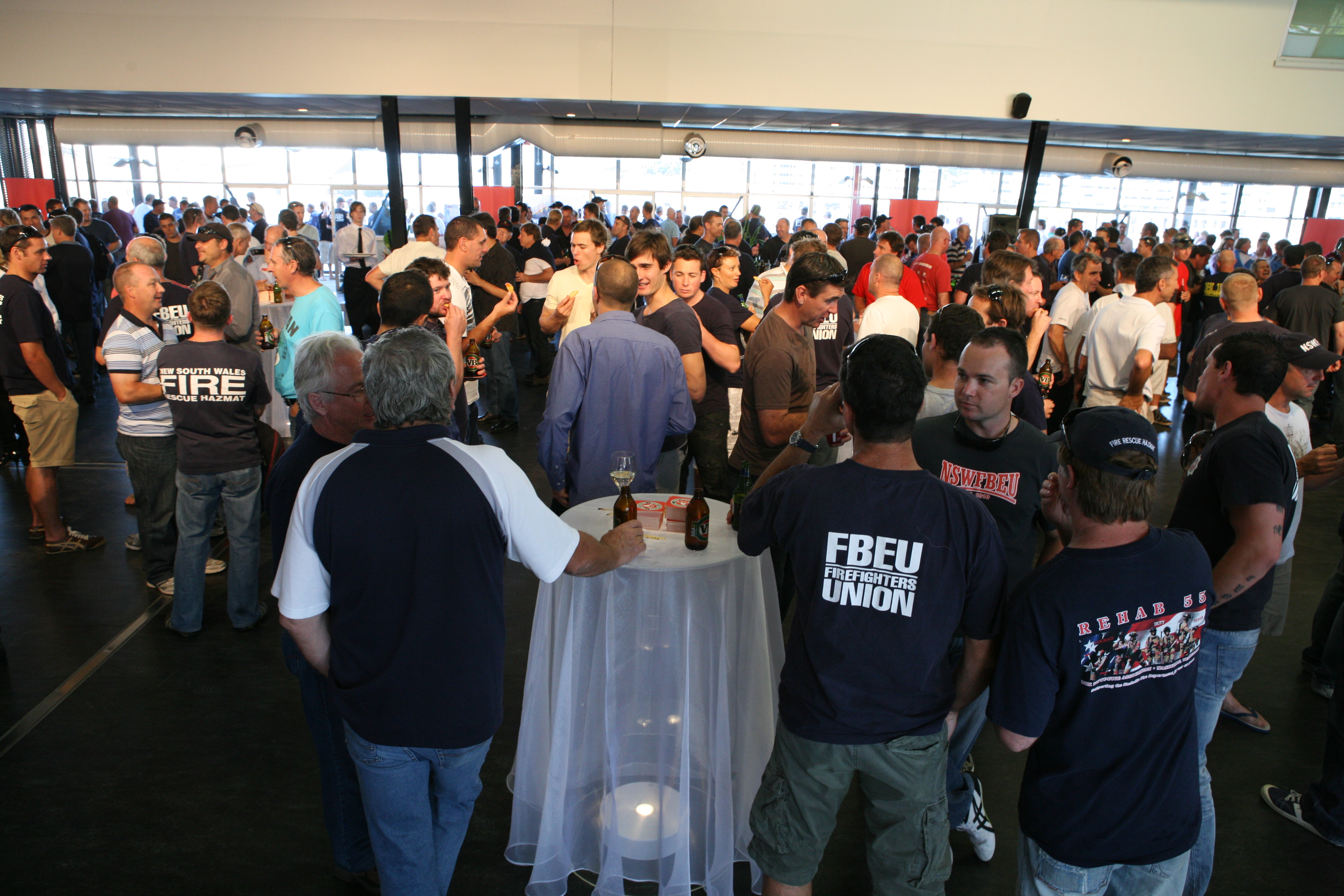
I know it's an Ad, but it had to be blogged.....
Via: http://flashovertv.firerescue1.com/media/814-What-if-Firefighters-Ran-the-World/
What if #firefighters ran the world | #AusPol
I know it's an Ad, but the theme was too good not to blog....
75 Years Ago Today, the First #Occupy | a note from Michael Moore

Friday, December 30th, 2011
The workers couldn't take the abuse from the corporation any longer. Their working conditions, the slave wages, no vacation, no health care, no overtime -- it was do as you're told or get tossed onto the curb.
So on the day before New Year's Eve, emboldened by the recent re-election of Franklin Roosevelt, they sat down on the job and refused to leave.
They began their Occupation in the dead of winter. GM cut off the heat and water to the buildings. The police tried to raid the factories several times, to no avail. Even the National Guard was called in.
But the workers held their ground, and after 44 days, the corporation gave in and recognized the UAW as the representative of the workers. It was a monumental historical moment as no other major company had ever been brought to its knees by their employees. Workers were given a raise to a dollar an hour -- and successful strikes and occupations spread like wildfire across the country. Finally, the working class would be able to do things like own their own homes, send their children to college, have time off and see a doctor without having to worry about paying. In Flint, Michigan, on this day in 1936, the middle class was born.
But 75 years later, the owners and elites have regained all power and control. I can think of no better way for us to honor the original Occupiers than by all of us participating in the Occupy Wall Street movement in whatever form that takes in each of our towns. We need direct action all winter long if we are to prevail. You can start your own Occupy group in your neighborhood or school or with just your friends. Speak out against economic injustice at every chance you get. Stop the bank from evicting the family down the block. Move your checking and credit card to a community bank or credit union. Place a sign in your yard -- and get your neighbors to do it also -- that says, "WE ARE THE 99%." (You can download signs here and here.)
Do something, anything, but don't remain silent. Not now. This is the moment. It won't come again.
75 years ago today, in Flint, Michigan, the people said they'd had enough and occupied the factories until they won. What is stopping us now? The rich have one plan: bleed everyone dry. Can anyone, in good conscience, be a bystander to this?
My uncle wasn't, and because of what he and others did, I got to grow up without having to worry about a roof over my heads or medical bills or a decent life. And all that was provided by my dad who built spark plugs on a GM assembly line.
Let's each of us double our efforts to raise a ruckus, Occupy Everywhere, and get creative as we throw a major nonviolent wrench into this system of Greed. Let's make the politicians running for office in 2012 quake in their boots if they refuse to tax the rich, regulate Wall Street and do whatever we the people tell them to do.
Happy 75th!
Yours,
Michael MooreMMFlint@MichaelMoore.com
@MMFlint
MichaelMoore.com
Friday, December 30, 2011
Rank and File | #tripleJ Unearthed | indy music #AusUnions

mixes Melvins, Nirvana, Led zep like riffs ...to blend with Kronic D's opiate based hip hop miracle verses to form a style of music only otherz have attempted to achieve..ie Faith no more, Korn, Limp Bizkit..etc
called 'union hip hop'..we represent the values of the MUA
never b defeated!
Janitors Across The Country Pledge to Support NYC Office Cleaners As Strike Deadline Looms

Janitors Across The Country Pledge to Support NYC Office Cleaners As Strike Deadline Looms
BY ASHLEY WOOD
PHOTO: NYC BUILDING WORKERS RALLY FOR FAIR CONTRACT ON DEC 14TH CREDIT: DAVE SANDERS
Janitors across the country are standing with New York City office cleaners and building service workers who are prepared to strike when their contract expires at the end of the year.
Earlier this month, thousands of New York City office cleaners and commercial building workers voted to authorize a strike at over 1,500 commercial office buildings if a deal is not reached between SEIU 32BJ and the Realty Advisory Board, an industry association representing most building owners, by 12:01 am on January 1st. The workers are seeking a fair contract that would preserve good jobs with wages that keep pace with the cost of living in New York City, as well as maintain the benefits many families rely on, such as affordable healthcare and sick days.
As the contract deadline looms for 22,000 office cleaners represented by SEIU 32BJ, janitors in more than 12 cities have pledged to honor picket lines should the strike spread outside of New York City.
The showdown comes as our nation is in the midst of wide-scale public protests over income inequality between the very wealthy and the rest of the country and a debate about what kind of country we will become if income disparity continues to widen. While corporate executives are making record amounts, income for 95 percent of American households has either stayed the same or fallen since 1970, threatening to make the middle class the great disappearing act of the 21st century.
Janitors in Northern Virginia, Pittsburgh, Philadelphia, Chicago, Orange County, Los Angeles, Oakland, San Diego, Boston, Seattle, Minneapolis and Sacramento have all signed petitions stating their intention to honor picket lines should the strike spread to their buildings.
Here are more ways to learn what's happening in New York City and across the country -- be sure to check back for updates:
Listen to interviews on KQV 1410 AM Radio on why office cleaners and activists in Pittsburgh are rallying today in support of NYC workers: "SEIU Solidarity with NYC"
Stay updated on Twitter by following the hashtag #32BJstrike.
Learn more about the tens of thousands of 32BJ building workers who have fought for good jobs this year at www.standwithbuildingworkers.org.
Watch the video below from one member on what a fair contract means to his family.
#FRNSW Fire Fighter injured during house fire in Vaucluse | @fbeu @NSWFBEU

At around 2.00am NSW Fire & Rescue responded to calls that a house was on fire in Greycliffe Ave in Vaucluse.
Neighbours heard screams from the front garden of the property as a male tried to save his home using a garden hose.
The first arriving appliance was from Bondi fire station. Upon seeing the size of the fire, they called for immediate assistance.
Other appliances were just finishing up at another fire scene in Paddington whilst the urgent call for assistance was made.
The male resident was treated by Paramedics for smoke inhalation but did not suffer any serious affects. He remained on scene and was comforted by neighbours and emergency personnel.
During the dangerous operation a fire-fighter fell through a floor that was weakened by the blaze. He managed to make it out of the building and to the nearby ambulance; however, he collapsed upon reaching the area of safety in severe pain.
Paramedics were notified of fire fighters need for medical attention and he was immediately treated on scene and later transported to hospital. His injuries are not life threatening, however a number of ribs are believed to have been broken during the fall.
Clean bowled in cricket, but they’ll clean us up in energy | Article | The Punch

Anyone watching India knows that they are beating Australia hands down at all three. India is set to win while the complacent, lucky country seems sure to waste its natural advantages.
Obviously, after the events at the MCG yesterday, I am talking not of cricket, but of energy security.
Australia is blessed with full diversity of energy resources: oil, coal, gas, uranium, solar, wind, waves and river hydro.
But we lack the determination to take any tough decisions. Instead of accepting climate change and the switch away from fossil fuels, Australia is stubbornly praying that a technological quick fix will allow us to avoid changing.
The Indians have set a policy to get solar power cheaper than our beloved exported Australian coal. The policy is not some vague aspiration either. It is to get to “solar grid parity” by 2022. That is a decade from now.
This means that the Indian government and scientists are planning that home-grown solar industries will be generating electricity cheaper than electricity generated by our Australian coal in a decade.
If you are one of these conspiracy theorists who think that sounds like propaganda, suck it up; KPMG said last year that India’s solar power will start to beat coal in domestic markets by 2017.
Meanwhile, back in the Lucky Country, we are stifling solar and wind and sending newcomer coal seam gas out to bat.
Despite our renewable energy riches, we are unable to keep up preventing up with the Indians, Chinese, Americans and Germans. Our politicians have filibustered-away our world-beating lead in solar technology and driven our best solar scientists off shore to work for our competitors.
Despite all the media propaganda about India (and China) being gung-ho for coal and nukes, they are busy building solar and beating us at our own game.
Germany and the US and Australia were solar leaders but India has a game strategy to get ahead in the competition for a clean energy economy. India’s strategy is to capitalise on what is called “late mover advantage” (or “second mover”) to leap ahead.
Poor rural Indians who lack electricity are not going to go to coal, then ‘transition gas’ then renewables. No chance. The fact that most of our commentators can’t take is that solar PV is now a proven, cheap technology.
The poor of Asia will go direct to decentralized, efficient, cheap solar power, without a wasteful detour into coal or gas. That is the advantage of being a late mover in the technology of energy.
The German industry in particular has been the centre of innovation and driven down the price of solar electricity. India now gets the advantage of coming in late, when the prices and risk are low. This is why they can be confident enough of the technological “learning curve” rate to predict that the falling cost of solar will cross over the rising cost of coal by 2022.
If Australia does not wake up, the Indians and Chinese will take all the clean energy wickets. The lucky, sunny country only has a few more innings before the game will be decided. Its time to get our eye back on the ball.
NSW Fire Union Rule's notification SITREP 50 of 2011 | @FBEU

FBEU Rule amendments update
As reported in SITREP 49, the State Committee is proposing twenty-three much needed amendments to the FBEU Rules. Many of these amendments are an exercise in updating parts of our Rules, such as increasing the mortality benefit. Others are part of a more significant reform agenda. Most important are those Rules that deal with the Sub-Branches and those concerned with the process of the general meetings.
If these changes are adopted it will grant members the right to amend any general meeting motion from the floor of the meeting itself. This is a long overdue democratic reform and our Union will be the stronger for it. As an adjunct to this change the State Committee is also proposing a reworking of Rule 11 dealing with the fifty signature mechanism by which members can call for a general meeting to vote on a given motion.
The State Committee is proposing that any such fifty signature motion will be required to have a mover and a seconder, and that these members are to work with the Union’s Executive in determining the wording of the motion so as to ensure that it clear, concise, and consistent with the Rules of the Union. Over the last week there has been some concern raised as to this second point – the role of the Executive in the process.
Consequently the State Committee met today to amend the wording of the proposed Rule 11 (4) (b) to make it clear that it will be the mover and the seconder of the motion, in consultation with the Executive, who will determine the wording of the motion – not the reverse as the amendment currently reads.
The proposed Rule 11 (4) (b) now reads:
11 – GENERAL MEETINGS
(4)
(b) The final wording of the motion or motions to be placed on the agenda of a Special General Meeting called under the preceding sub-rule shall be determined:
(i) in the case of a request from two or more Sub-Branches made pursuant to subrule (4)(a)(i), by the relevant Sub-Branch Executive Committees in consultation with the State Executive; or
(ii) in the case of a request from members made pursuant to subrule (4)(a)(ii), by the mover and seconder of the motion or motions in consultation with the State Executive.
The twenty-three Rule amendments in their entirety are available here.
Members are reminded that these proposed changes shall take effect on 20 January 2011 unless a request for a plebiscite signed by one fortieth of all financial members is received by that date. Any such request needs to state which amendment, of the twenty-three proposed, is to be challenged.
Finally, Happy New Year to all members and their families. While it seems likely that 2012 will be tumultuous year for the FBEU, our Union is in as good a condition as it has ever been to do what we do best – defend not only our wages and conditions, but also our dignity at work.
Thursday, December 29, 2011
Daily Kos: Why The Oligarchs Want to Ghettoize The Country

It works like this... The most important assets for a free people are time and leisure. Once you have that, then you can develop the ability to think critically, to analyze facts, events, trends, and to become aware of the dynamics that operate within a social system.
In a society, once a large-enough segment of the population has developed an understanding of how the system works, you then have an informed citizenry who is able to act in favor of their interests.
So in a healthy democracy where the population is informed and educated, you will not have a very marked disparity in income distribution between the population and the rich.
So having access to time and leisure, leads to an improved ability to think, to analyse, and to become aware about how the system works. This in turn leads to the ability to organize with other informed citizens to take collective actions to safeguard your interests.
For the citizenry, this results in having a larger share of the nation's income, wealth, and power.
That's why the oligarchs are always (eternally) trying to find ways to chip away at the ability for the common man to be able to have access to idle time and/or leisure.
That explains the hundreds of millions of dollars certain business organizations and lobbying groups spend on bribing politicians nationwide to setup a legislative framework to make it harder for workers to unionize, to make education less accessible, to destroy the proper functions of government.
When it comes to power, the most significant component is income and wealth, especially in a capitalist system.
Once people fall into poverty, they become powerless (by and large); that's why you hardly see politicians talking about the poor. They are always talking about the "middle class."
And it does not matter how large the segment of the population falling into poverty may be. For example, a population that has a 10% incidence of poverty, is as powerless as a population who has 80% living in poverty (in my opinion).
Right now (as you read this), there is a segment of the population who has vast wealth and it's using it to manipulate the bought off politicians nationwide (federal, state, counties, cities) to push "austerity measures" onto the citizenry.
These austerity measures have the effect of curtailing access to education, health care, and a plethora of workers' rights.
As these very well-planned policies take effect, the average worker then has less time, and less leisure. This immediately translates into a rapidly-expanding wealth gap between the rich, an the rest. As the rich become richer (aided by the bribing of Democrats and Republican politicians across the entire country), and the poor become poorer, the percentage of the population who is poor also increases rapidly (as it is the case now).
As poverty spreads through the population, ignorance also spreads, since poor people don't have access to the proper infrastructure to get educated.
And here's the "brilliance" of the oligarchs. As the "hamster wheels" (as it were) are spun faster and faster, the workers try to keep up. Those who fall off the wheel, unable to keep up with the oppression and exploitation, then fall into poverty, and are quickly marginalized, stripped from any source of power, and ghettoized.
The dwindling middle class, seeing the wretched consequences of poverty are then intimidated and fearful, and do everything they can to stay on the wheel, picking up the pace mandated by the increasingly oppressive system.
But the system is rigged, which results in the inexorable rate increase of poverty and/or economic insecurity in the population.
And here's the biggest quandary: Once a citizen understands that the system is no longer legitimate, and that it is rigged in this way, does it becomes the duty of such a citizen to rise up in protest with the objective of stopping the system on its tracks, so it can be fixed?
Herein lies the inherent conflict between those who have come to realize that the system is broken, and that it's not longer legitimate, and therefore has to be stopped from operating normally, and those who because of fear and/or their inability to understand the situation still hang on to the notion that the system is "normal."
In every society where oligarchs rise, along with oppression and exploitation, it is the latter type of citizen who is the most responsible for it.
For once the system has turned totally corrupt, predatory, and criminal (as it's the case today in the United States), then patriotic and informed citizens have the duty to stop it from operating normally, in order to defend against a domestic enemy (the likes of ALEC, The US Chamber of Commerce, and other neo-fascistic organizations).
Such a system, if not stopped on its tracks, always leads to the following: A very tiny elite comprised of people with extreme wealth and a totally bought-off class of politicians (as it's the case now with the Democratic and Republican party establishments), in control of most of the wealth and power of the country, and a population living in a neo-feudal society.
We are way on our way to become such a society. All the hallmarks of a banana republic or third world country have been met, including rampant bribery of the political establishment, thievery and criminality at grand scale, with impunity and aided and covered up by bought off and corrupt politicians, the rise of an increasingly brutal police state.
The only question that remains is if the dwindling middle class is going to decide to cower in fear, remain on their knees, bowing down to large-scale criminals, or stand up for justice, freedom, and democracy.
We'll find out soon enough. If we decide to remain on our knees, we'll keep feeding the corrupt and exploitative system, which is rigged to eventually totally destroy the middle class and plunge the entire population into serfdom, and ignorance.
Socialist Alternative - Why workers can change the world

Karl Marx’s claim that the working class has the power to change the world is perhaps his most important contribution to socialist theory. Before Marx workers were viewed at best as victims of the system or more typically as a rabble whose existence threatened civilisation. Marx challenged these assumptions, arguing that workers’ collective struggles for freedom pointed towards a potential socialist alternative to capitalism.
This vision is widely disparaged today. However, criticisms of Marx often miss their target. This is particularly true of those who reject his model of class from “common sense” or sociological perspectives which tend to equate class with social stratification – the various ways of differentiating people along lines of income, status, occupation or patterns of consumption. What, it is asked, do university-educated teachers, factory workers or low-paid shop workers have in common?
Viewed from the perspective of these and other differences it seems obvious not merely that old patterns of class struggle are less relevant to politics than they once were, but more profoundly that actual patterns of difference are becoming so complex that appeals to class are out of date.
But this tendency to one-sidedly emphasise differences within the workforce only makes sense if stratification is viewed in isolation from the broader process of exploitation. Marx, by contrast, showed how capitalism’s complex process of exploitation creates not only a myriad of differences across the labour force, but also common relations that cut across differences of income, occupation, status, etc. It is these common relations that make a class a class. Marx’s model of exploitation does not lead Marxists to dismiss differences within the working class. Rather it points to a material basis for solidarity across these divisions.
Marx’s method
Marx’s approach to the study of class is best understood historically. He argued that although we can distinguish humans from other animals by all manner of criteria, our ancestors actually distinguished themselves from the natural world through social and purposeful work aimed at transforming nature to meet their needs. Of pivotal importance to this process was the Neolithic Revolution, the moment 8,000 to 10,000 years ago when groups of humans who had until then existed by foraging from nature, broke with ancient patterns of behaviour to begin cultivating crops.
By remaking themselves as farmers, humans for the first time had systematically to produce a surplus in order to reproduce their farms over time – for example, to provide for grain reserves to guard against bad harvests. This created a new social problem: who controls the surplus? Classes (along with states and women’s oppression) emerged when minorities – after a very long transitional period – fixed their control over the surplus produced by the rest of society.
Understood from this perspective, class is not a universal characteristic of human history but has a definite historical origin in the emergence of a particular relationship by which one group gained control over the social surplus produced by another.
This approach to the study of class has three great strengths. First, it allowed Marx to periodise history by examining the different ways that surpluses are extracted by the ruling class from the producers: for instance the way feudal lords exploit peasants is different to the way capitalists exploit wage labourers, and this results in different forms of social conflict in feudal and capitalist societies.
Second, by pointing to the origins of class this model illuminates the necessary conditions for the abolition of class: whereas class emerged when there was enough surplus to allow an elite to take control but not enough for these benefits to be enjoyed by everyone, the possibility of overcoming class divisions developed when the level of surplus rose to a point where these benefits could be generalised – something Marx showed capitalism had made possible.
Third, by putting the production of a surplus at the core of his model of class, Marx demonstrated the intrinsic relations between the wide variety of roles within the capitalist economy.
Indeed, Marx’s conception of capitalist class relations only makes sense in terms of his dynamic model of capital accumulation. Capitalism is a novel and uniquely dynamic mode of production that emerged when the direct producers (the peasantry) were removed from control over the land to become “proletarians”, people for whom survival depends on selling their ability to work in the labour market. This shift in social relations was incredibly important because it created the conditions by which capitalism became simultaneously the most dynamic and the most out of control (or “alienated” as Marx called it) social system known to history.
Peasant production
The relative stability of peasant production was rooted in the effective control peasants tended to have over the land: they produced largely for themselves (with a percentage being taken in tax by the lords) supplemented with a small amount of bartering or market exchange.
By contrast, the system based on wage labour is one in which workers are compelled to seek work wherever they may find it. This characteristic of wage labour allows capitalists to redistribute labour (through redundancies in one area coupled with growth elsewhere) from less to more profitable areas. Moreover, because production is for the market, capitalists constantly feel a pressure to innovate. Taken together, these conditions mean that labour will tend to be redistributed to the most efficient producers. Wage labour thus underpins a tendency for the productivity of labour to increase under capitalism.
Though Marx wrote a great deal on the relationship between wage labour and the dynamism of the capitalist system, he never finished the section of Volume Three of Capital in which he began to define class. Nevertheless, he left enough material for us to reconstruct a model of class from his works.
One important attempt to do this was made by Lenin. He defined class as a relationship: workers sell their capacity to work while capitalists buy these abilities. The great strength of this approach was its illumination of similarities between superficially different jobs.
Unfortunately, it is not a wholly satisfactory model. For instance, modern capitalism operates through senior managers who, like workers, often sell their ability to work, but who, unlike workers, are not exploited (indeed they play a key role in the exploitation of others). There are also other groups whose conditions of life overlap both with capitalists above and workers below them – middle managers, certain professionals and so on. These “new middle classes”, whose existence reflects the growing complexity of the capitalist labour process, tend to help maintain the exploitation of workers while simultaneously experiencing pressures that partially parallel those felt by these workers.
The most sophisticated attempt to reconstruct Marx’s theory of class in relation to the complex and developing social process of exploitation was outlined by Geoffrey de Ste Croix in his magnificent Class Struggles in the Ancient Greek World. He argued that, “Class (essentially a relationship) is the collective social expression of the fact of exploitation, the way in which exploitation is embodied in social structures... A class...is a group of persons in a community identified by their position in the whole system of social production.”
Exploitation
Once we think of class in terms of a complex process of exploitation and capitalism as a uniquely dynamic mode of production we can begin to understand how increases in the productivity of labour will lead to constant changes in the structure of the working class.
This has happened, for instance, in manufacturing. Though British manufacturing workers do not have the social weight they once did, increases in the productivity of labour mean that, despite the decline in the number of manufacturing jobs, in 2007 British manufacturing output was at an all-time high.
Not only does this imply that manufacturing workers can become objectively stronger at the same time as their absolute numbers decline, but it also suggests that the introduction of new technologies means that modern workers need very different skills than did their predecessors.
One result of these changes is that modern workers will have a very different level of formal education than did workers in the past. If in the past education was the preserve of the elite, today a formal education (at least to the level of basic literacy and numeracy skills and, for increasing numbers, to university level) is a necessary prerequisite for almost every job. This process has had two consequences.
First, workers are much better educated than ever before: indeed, the majority of modern workers are significantly better educated than were even the bulk of rulers from most of the past, and this helps prepare them to take democratic control over society as a whole.
Second, viewing the education system from the point of view of the capital accumulation process allows us to recognise how educators relate to other workers. Because industry needs educated workers, it needs educators. Moreover, because mass education is (in essence) a process designed to produce the next generation of workers, it is qualitatively different in function from earlier forms of education which focused merely on equipping the elite with the skills and confidence required to rule.
Most teachers today contribute educated workers to the production process, and they do this as wage labourers who sell their ability to work like other workers. This creates a life experience that increasingly parallels that of other workers: they are under constant pressure to increase their efficiency by educating more students at less cost.
A similar story could be told of the health and social service systems. Educated workers are (from the point of view of capitalism) an expensive resource, and it would be a waste to allow illness etc to remove them from the labour market. Like the education system, therefore, health and social service systems are best understood as essential to the process of exploitation. Consequently, those nurses, social workers, administrators and so on who work in these areas are best understood as part of the working class because of the role they play in maintaining the capital accumulation process.
This is not to say that the health and education systems can simply be reduced to the needs of capital – it is clear that social movements have put demands on these institutions which have broadened their functions in ways that escape capital’s narrow focus on boosting profitability. Nevertheless, because these structures essentially grew in response to the needs of capital, the vast bulk of those who work in them are best understood as part of what Marx called the “collective labourer”.
Common interest
By generalising this perspective we can grasp that despite workers doing innumerable different jobs of different status and at different rates of pay, they are all part of the exploited collective labourer, and they all experience similar pressures to increase their productivity. There exists a common interest across the working class to (collectively) resist capitalist exploitation in the name of a democratic alternative that does away with exploitation altogether.
By contrast, capitalists are those who sit atop this process of exploitation and who surround themselves with layers of functionaries- managers, the judiciary, an apologetic media, the police, the army, etc-who act to ensure the continuation of the conditions of exploitation. However, while capitalists command the exploitation process, production for the market ensures that they, like workers, are alienated because they have no overall control over a system governed by blind, unplanned competition between rival capitals.
Though capitalism ensures that everyone is alienated, capitalists not only benefit from control over the exploitation process but also tend to experience this alienation as freedom and self-realisation. Workers, by contrast, are exploited and tend to feel degraded by their experience of alienation.
These differences create an antagonistic relationship which means that capitalism is best understood not simply through class divisions (stratification) but more profoundly as a system of class struggle. Exploitation as a social process not only creates objective links between various workers as part of the collective labourer, but also creates an antagonistic relationship with the capitalists and those upon whom they depend for the smooth running of the system: those who the Russian Marxist Bukharin called – in a slightly different context – the “collective exploiter”.
Once we recognise that class struggle rooted in exploitative relations is at the core of the capitalist system, we can see that workers have a unique power within capitalism. Because the system depends upon the exploitation of wage labour, workers have the potential power to bring it down.
Why the working class?
This is why Marxists argue that anti-capitalists should orientate towards the working class. We have no illusions about workers being angels, but we do recognise that they have the strategic power to turn off the flow of profits. And it is the emergence of this collective labourer that creates the potential for the producers to replace alienated market relations with democratic control over the production and distribution of the social surplus: socialism.
While refusing to romanticise workers, we nevertheless recognise that in order to develop the collective organisations necessary to resist and ultimately defeat capitalism they must overcome the divisions within their ranks. They must struggle for solidarity to overcome not only the various forms of stratification noted above, but also those numerous divisions along lines of oppression – racism, sexism, homophobia, etc. – by means of which the working class is often divided against itself.
Whereas contemporary cultural theorists tend, like sociologists of class, to fixate on the differences between various oppressed groups, once we recognise that all members of these groups are in fact integrated one way or another into the capitalist process of exploitation, we can begin to see a basis for universal liberation.
By contrast with those who conceive oppression merely as difference, our argument that the working class includes all those who are related to the (broadly conceived) process of exploitation allows us to grasp how it includes not merely workers of various types, but also workers from every oppressed group alongside the “reserve army” of the unemployed and those unwaged labourers who by staying at home with children, for example, help reproduce the workforce.
From this perspective it is clear that workers’ solidarity can only be won by constantly challenging all those forms of oppression that divide these various groups against each other. This is why Lenin insisted that socialists should act not merely as trade union secretaries but rather as “tribunes of the oppressed”. It is also why Marx called the modern working class the “universal class”. He recognised that for workers to win their freedom they must struggle collectively for real democracy, and because he understood class in a broad sense he recognised that, though workers’ “self-emancipation” must be won in struggle against the capitalist class, it could only be won through the general emancipation of humanity.
The return of resistance
Finally, if the possibility of a socialist alternative to capitalism is rooted in those daily forms of solidarity practised by the collective labourer, it is in large part because the workers’ movement has been in retreat since the 1980s that this image of an alternative to capitalism has gone out of favour.
The return of mass strikes from Egypt, to Greece, to Britain creates the potential for turning this situation round. Anti-capitalists can help this process by making links with the workers’ movement, and hopefully this article has given some sense of why they should: workers solidarity has the potential not only to bring capitalism down but also to replace it with a democratic socialist alternative.
First published at socialistreview.org.uk.
Julia Gillard and #ALP rally - but not in states they need to win | The Australian #auspol

IMPROVED support for Julia Gillard and Labor among women, older people and voters in South Australia and Western Australia has boosted the government at the end of the year - but it still faces an election-losing wipeout in Queensland and NSW.
Labor remains most vulnerable in the states where the most seats are to be won or lost.
The latest Newspoll analysis reveals it would lose up to 17 seats - including a raft of ministers - in Queensland, NSW and Victoria based on swings against the government in each state.
In Queensland, Labor would lose six seats, in NSW eight Labor seats could fall and in Victoria three marginal seats would go based on statewide swings since the election. According to a Newspoll analysis of surveys conducted exclusively for The Australian, the Prime Minister regained lost ground among female voters and in her home state of Victoria, with Labor recovering slippages in WA and South Australia in the last quarter of the year.
RECOMMENDED COVERAGE
Sympathy for Julia in Abbott dogfight
Massive strides needed in vital seats
Cumulative Newspoll
After Labor's lift in the October-December period, it now has a primary vote over 30 per cent in Victoria and South Australia and is equal to the Coalition on a two-party-preferred basis in those two states. The politically action-packed last three months of the year resulted in Labor's support rising from record lows in the June-September quarter on the back of improvements in Victoria and South Australia.
Both states are seen as having a special connection with Ms Gillard, the Prime Minister having grown up in Adelaide before making Victoria her home.
Despite the improvement in the past three months, Labor's primary vote is down across the board from the beginning of the year and down from between two to 10 percentage points since the August election last year.
Labor's two-party-preferred support has also suffered because slight falls for the Greens, particularly in South Australia, mean a reduced preference flow to Labor.
In NSW, where Labor holds 26 seats, the ALP primary vote is down 10 points to 28 per cent since the election. In Queensland, where there are eight Labor MPs, the primary vote is down four points to 29 per cent since the election. Despite a three-point rise to 35 per cent in Victoria in the last quarter, Labor's primary vote is still down seven points on its election vote in 2010. Five-point rises in Western and South Australia in Labor's primary vote - to 29 per cent and 33 per cent respectively in the December quarter - are still down on the election.
On a two-party-preferred basis, using preference flows at the last election, the Coalition is ahead or equal to the government in every state and in front on primary support among every demographic and regional group.
The Coalition leads Labor on a two-party preferred basis in Queensland 59 per cent to 41 per cent and in NSW and Western Australia 57 per cent to 43 per cent. In Victoria and South Australia, after rises in the ALP's primary vote in the past three months, the government is even with the Coalition on 50 per cent after the calculation of preferences.
Personal support for Ms Gillard rose from record lows in most states and among various groups of voters, but her satisfaction remained below 30 per cent in Queensland and among male voters.
After a fall among women voters in the September quarter, Ms Gillard's support rose four points to 34 per cent, her second-lowest rating among women, and increased five points in Western Australia.
But in Queensland satisfaction with the job the Prime Minister is doing was unchanged on 25 per cent, and with male voters went from 27 per cent to 29 per cent.
On the question of who would make the better prime minister, Ms Gillard widened her lead over Tony Abbott in Victoria and South Australia and narrowed the Opposition Leader's preference in NSW to just one point, 39 per cent to 40 per cent.
Mr Abbott's biggest leads over Ms Gillard as preferred prime minister are in Queensland, 42 per cent to 32 per cent, and among male voters, 53 per cent to 43 per cent.
Ms Gillard improved her lead over Mr Abbott among women. After going to within two points of the Prime Minister in the September quarter, the Liberal leader now trails her 33 per cent to 42 per cent.
After reaching record levels of support in Victoria and South Australia, the Greens have dropped back to the levels of primary support at the election last year or below.
In NSW, where ALP support has dropped, the Greens have kept 13 per cent primary support in the last half of this year, which is two percentage points up since the August election.
In Victoria, Greens' support has dropped back to 2010 election levels after hitting highs of 17 per cent and 16 per cent in the first half of this year.
In South Australia, there has been a similar movement in Greens' support, dropping back to 11 per cent last quarter after rising to 16 per cent during the announcement of the carbon tax in the March quarter.
Wednesday, December 28, 2011
Unions NSW End of Year Video - and what a year it was for #Ausunions | @UnionsNSW @fbeu
And what a year it was !
#BarryOFarrell hits Wayne Swan for aged-care sprinklers | The Australian | #FRNSW

Barry O'Farrell hits Wayne Swan for aged-care sprinklers
BY: AMOS AIKMAN From: The Australian December 28, 2011 12:00AM
NSW Premier Barry O'Farrell has written to Acting Prime Minister Wayne Swan asking for hundreds of millions of dollars to retrofit nursing homes with sprinklers in the wake of a fire that killed 11 elderly residents.
About two thirds of the state's roughly 900 aged-care facilities do not have sprinklers, a figure National Seniors of Australia chief executive Michael O'Neill described as "shocking".
"We are talking about our most vulnerable Australians - they're in nursing homes because they need help with basic daily needs," Mr O'Neill said. "Sprinklers are a basic standard that we expect in our childcare centres, schools and hospitals - why not nursing homes?"
Eleven residents of the Principal Quakers Hill nursing home in northwest Sydney died last month after fire swept through the building in the early hours of the morning. A staff member has been charged with multiple counts of murder.
Victoria and Queensland require all nursing homes to have sprinklers retro-fitted, but NSW does not.
The Australian understands a government audit has determined 636 aged-care facilities in NSW do not have sprinklers, and estimated the cost of fitting them at between $236 million and $700m, subject to private-sector contributions. Most of the homes not retro-fitted with sprinklers were built before they were made compulsory in 2002.
A spokeswoman for Federal Ageing Minister Mark Butler said the government received a letter from Mr O'Farrell last week and would respond. Spokesmen for the Premier and NSW Ageing Minister Andrew Constance declined to comment.
Fire and Rescue NSW says there is no question sprinklers help save lives.
But Illana Halliday, chief executive of the Aged and Community Services Association, which represents the not-for-profit aged-care sector, told the ABC yesterday her members could not afford to fit sprinklers.
"We would need to seek funding for that," she said.
En Passant » Stop the yachts

Boxing Day in Australia is the day of sales and sails. And the first day of the cricket at the MCG.
The test broadcast started half an hour early. This as to enable us to watch the beginning of the Sydney to Hobart yacht race at 1 pm during lunch at the cricket.
Overturning the 11 am traditional start time of the cricket for a yacht race. Is nothing sacred?
As Marx and Engels so eloquently put it in The Communist Manifesto:
All fixed, fast frozen relations, with their train of ancient and venerable prejudices and opinions, are swept away, all new-formed ones become antiquated before they can ossify. All that is solid melts into air, all that is holy is profaned, and man is at last compelled to face with sober senses his real condition of life and his relations with his kind.
That is what is happening in cricket as both the focus of power shifts to India and the commercialisation of the game makes tests compete with Twenty20 big bashes for our sporting dollar.
But this is not about cricket. It is about yachting, in particular maxi yachts.
The Sydney to Hobart yacht race has always been a plaything of the rich. But it too, like cricket, has become more commercialised. Now the boats of the super rich carry advertisements for sponsors.
The supermaxi Wild Oats XI is the favourite to win line honours. Billionaire Bob Oatley owns it. He also owns Hamilton Island and the Wild Oats, Robert Oatley and Montrose wine labels.
As D D McNicoll put it in the Australian:
Having a new supermaxi designed and built today would cost up to $10 million then with over $1m a year to campaign the yacht and keep it competitive. Moving it around the world to contest the major long-distance ocean races would double annual costs.
Those costs make winning the Sydney to Hobart Yacht race the preserve of the rich and the race their plaything.
Yachting is an exclusive sport. It is the polo of the sea. And as everyone seems to remark, watching sailing is like watching grass grow, or paint dry.
Of course there are many less well off sailing enthusiasts. Indeed most of the members of sailing clubs own fairly cheap off the beach boats. They are sailing, not yachting.
They are as divorced from the Sydney to Hobart as you and me. They are not in the race.
Imagine if we used the money the rich waste on this frivolous exercise to better health and education in Australia. Imagine remains merely a John Lennon song, unfortunately.
The Sydney to Hobart yacht race is a race for the billionaires and multi-millionaires, the one percent. These people lead a very different life to us. They don’t and won’t mix with the rest of us. They live in rich ghettos. They speak a different language of finance and investment and money. They even eat differently. We don’t want them here. It’s time to turn back the yachts.
Anarchism and the death of social democracy - On Line Opinion - 22/12/2011
Anarchism and the death of social democracy
By Marko Beljac - posted Thursday, 22 December 2011 Sign Up for free e-mail updates!
Gillard's ministerial reshuffle has been likened to arranging the deck chairs on the Titanic. Analysts differ on what constitutes the sinking ship; is it Gillard's prime ministership? The Gillard government? The Australian Labor Party?
All seem agreed, however, that Gillard's ministerial reshuffle will do little to alter the ultimate fate of the sinking ship, whatever it may be.
The underlying motivation behind the reshuffle has also attracted the attention of analysts as it seems to have rewarded the froth - Arbib probably doesn't know how to spell his own name and Shorten's ego hides an essential mediocrity, which brought Gillard to power and supported her "leadership" at the recent National Conference. The reshuffle itself appears also to have been enabled by the defection of Peter Slipper.
Advertisement

The entire affair is mainly a sideshow best left for discussion on ABC Insiders, which usually focuses on such trivialities.
My interest here is directed toward the ship, not the deck chairs.
I submit that what is sinking is social democracy itself.
That social democracy would fail was foreseen eons ago from within the Left, most specifically from the libertarian wing of socialist thought otherwise known as "anarchism" or better still "anarcho-syndicalism."
But why say that social democracy has failed?
We forget that what we call "social democracy" initially was meant to serve as the parliamentary road to socialism. To be sure social democracy, especially that associated with the German SPD, in its early days was programmatically Marxist. But the revisionism of Eduard Bernstein served to codify the practical existence of a more evolutionary and parliamentary approach to socialism. In other countries, such as the United Kingdom, where Marxism was not as prevalent within the labour movement, such codification wasn't really necessary.
Advertisement
The key idea of the social democratic approach was that socialism could come about by something akin to an algorithmic procedure; step-by-step through piecemeal reform enacted by democratically elected governments, rather than through a singular extra parliamentary revolution.
This idea found its most important expression in Australia with the socialist objective of the Australian Labor Party and the Australian Council of Trade Unions.
In reality social democracy, to a greater and lesser degree, everywhere became associated with the development of a social contract between capital and labour. Australia was no exception.
Discuss in our Forums
See what other readers are saying about this article!
Click here to read & post comments.
8 posts so far.
About the Author
Marko Beljac has been awarded a PhD at Monash University and he has taught at the University of Melbourne. He is interested in the interface between science and global security and currently is writing a book on nuclear terrorism. He maintains the blog Science and Global Security and is co-author of An Illusion of Protection: The Unavoidable Limitations of Safeguards on Nuclear Materials and the Export of Australian Uranium to China.
Other articles by this Author
All articles by Marko Beljac
- » Pessimism of the intellect, optimism of the will - December 1, 2011
- » Julia Gillard's u-turn on selling uranium to India exposes Labor's decay - November 21, 2011
- » The primitive country? - September 23, 2011
- » Has Rudd bought the intelligentsia? - February 10, 2010
- » The moral degeneration of the Labor Left - January 15, 2010
This work is licensed under a Creative Commons License.




Interesting read.. Sorry about the ads...
Tuesday, December 27, 2011
Check this out- Oz shock-jock distortion tactics | guardian.co. #cp #carbontax

Australia has unwittingly become a social experiment. A ruthless experiment on the fate of a society when a single media conglomerate, Rupert Murdoch's News Corp, owns 167 newspapers and controls around 70% of the printed media market.
After the phone-hacking scandal rocked Britain, News Corp officials in Australia struggled to put some daylight between its local operations and the rest of the empire, assuring the public that the country was spared phone hacking and other unethical practices. It is perhaps unlikely that wire tapping or phone hacking was practiced in Australia, simply because the local specialty of the Murdoch organs and their shock-jock allies has been a fairly low-tech reliance on outrageous spin.
Sunday, December 25, 2011


Friday, December 23, 2011
NSW Firefighters Union @fbeu SITREP 49 of 2011 | #Ausunions

SITREP 49 of 2011
December 23, 2011
Notice of Rule Amendments
FBEU members exempt from leave direction
Union Office Xmas/New Year Shutdown
Notice of Rule Amendments
Members are advised pursuant to Rule 47 that the State Committee of Management today resolved to adopt a number of Rule amendments. The amendments:
bring our Rules up to date in respect of both our representative structures, our elections and our financial controls; and
expand the number of Sub-Branches from 10 to 13 and consequently, the State Committee; and
allow members a greater opportunity to participate in our decision making processes including the capacity for members to propose amendments to General Meeting motions; and
increase member control over future rule amendments; and
include numerous other important reforms such as increasing members’ mortality benefits from $3000 to $5000, providing greater precision for the timing of the Union’s tri-ennial elections timetable and a re-writing of Rule 51, Sub-Branches.
The amendments adopted by the State Committee can be accessed here.
If the State Secretary does not receive a request by 20 January 2012 for a plebiscite upon the decision of the State Committee of Management signed by at least one fortieth of the financial members of the Union then the amendments shall, subject to the provisions of the Industrial Relations Act, 1996 and the Regulations, come into operation on 20 January 2012.
FBEU members exempt from leave direction
The Department of Premier and Cabinet has again issued a blanket direction to all non-emergency services staff to take leave which our employer last year tried to pass on by directing members at the College to take leave over the Christmas period.Members are reminded (as per SITREP 45/2010) that no FBEU members, including those in Operational Support positions, are required to stand down or access their own leave over the Christmas period and cannot be directed to do so.
Union Office Xmas/New Year Shutdown
The Union Office will close for its annual Christmas/New Year break at 1200 hours today, Friday 23 December and resume operations on Wednesday 4 January 2012. Members requiring assistance over this time may contact an on-shift SCOM official (see http://fbeu.net/contact-us/scom-details/) or email us at office@fbeu.net
I again take this opportunity on behalf of the Union’s officials, industrial and administrative staff, to wish all members and your families the compliments of the Season.
How they treat female protestors: from Cairo to Melbourne

Via : http://enpassant.com.au/?p=11851
In Cairo the Egyptian military brutally beat a female protester, stripping her down to her bra by removing her abaya and then stomping on her breasts. Here is a link to the video.
In Melbourne the Victorian police surrounded a young women dressed as a tent, removed it and left her in her underwear in a public park. Here is a link to the video.
What’s the difference?
In Melbourne some Occupy Melbourne people protested on White Ribbon Day against police violence against female demonstrators. Here is a link.
In Cairo 10,000 women demonstrated against the Army, asking where the field marshal was. Here is a link to the video.
Magnificent. The women of Egypt are showing all of us we need bigger and bigger demonstrations against the inhumanity of our rulers and their armed thugs. We need a revolution to win the liberation of women and all humanity.
A well deserved payrise for these upstanding citizens | #Auspol | The Punch

Via: http://www.thepunch.com.au/articles/a-well-deserved-pay-rise-for-these-upstan...
Just when we thought that politics had started its summer holidays, and the “big questions” were put aside for a while, the Remuneration Tribunal released its report on Commonwealth parliamentary salaries and entitlements. The public reaction was immediate, and in the overwhelming majority, intensely negative.
A collection of Australia's finest folk Picture: Gary Ramage
The cause of the anger was the proposal to lift the basic salary of a member of parliament from $141,000 to $185,000 per year. The Tribunal provided its justification: the need to “remunerate them sufficiently so as to attract and retain men and women of appropriate capacity”. No argument about the aim. We would all like our representatives to have the “appropriate capacity” to serve us.
Currently many people who would be good parliamentarians could not tolerate the party apprenticeship demanded to win pre-selection, especially for a safe seat. In the Labor party, the gene pool of “capacity” seems increasingly restricted to those showing dedicated service to the party, a union and/or faction, and often service as a ministerial minder.
The Liberal party seems to be moving in a similar direction (except for the union component). For the Tribunal’s aim to work, it will need the parties to open their “welcome door” much wider.
Politicians will be pleased with their payrise. Up to now, politicians have bolstered their financial situation with a raft of allowances and entitlements. This softened the impact when they were unable to get increased salaries.
But the Tribunal has correctly had a close look at some of these, and the tactic is definitely over. One reason is that the Tribunal has, for the first time, divided parliamentary entitlements into two baskets.
One is remuneration, the personal benefit side. The other has been put under “business expenses” – the costs incurred in undertaking their duties and responsibilities. This has been the growth area, and much of it could be categorised as perks. The Tribunal has made some major cuts.
One perk abolished is the famous Life Gold Pass. Currently, any MP who retires after 20 years of service receives 25 free Australia-wide business-class flights per year for life. MPs with less than 20 years receive between six months and five years of free flights.
This was first introduced in 1913 (when it was free train travel), and it has become a major perk. The Tribunal has proposed that, as a transition stage, for existing Pass holders the perk should be reduced from 25 to 10 flights. This is not strong enough. It should be abolished for all current MPs and all current Pass holders as well.
A second perk, which has certainly slipped over the edge to a rort, is the MPs entitlement to free first class world travel once every three years. This is officially called “overseas study”, but its justification has been severely tested.
Not only have some “study tours” increasingly been to famous tourist destinations, but there has been a growth in numbers of retiring MPs who took “a lap of honour”. The Tribunal has cancelled this entitlement completely.
I have always held that if a member of parliament is doing the job properly, he or she has been underpaid. So I am not as upset as some people have been about the salary rise. On the other hand, it would be good to see fewer party hacks enjoying the rise. Parties choosing more “appropriate capacity” representatives would help.
The Tribunal could have gone further in cutting more of the allowances and entitlements, such as free printing and postage for party propaganda. That is where some “fat” can really be found. But the payrise? Probably deserved by most members of parliament.
Our pollies’ 2011 report card | The Punch | #Auspol

Let’s get one thing straight up front. Julia Gillard and Tony Abbott probably deserve points merely for surviving this arduous first calendar year of minority government. With everyone on a steep learning curve, the most obvious lesson is that there is a parallel between minority parliament and the concept of dog years: twelve months of this ages a government like the full three years of a normal term.
We refuse to caption this image on the grounds we may incriminate ourselves
The other lesson is that while Julia Gillard has shown she is as tough as nails, simply refusing to blink, Tony Abbott has also adapted to the situation better than he’s been given credit for.
So, to some ratings.
http://www.thepunch.com.au/articles/someones-getting-grounded-our-pollies-201...
Thursday, December 22, 2011
Important road #safety message


I thought I'd share an experience with you all, about drinking and driving.
As you well know, some of us have been known to have had brushes with the authorities on our way home from the odd social session over the years.
A couple of nights ago, I was out for a few drinks with some friends and had a few too many beers and some rather nice red.
Knowing full well I may have been slightly over the limit, I did something I've never done before - I took a bus home.
I arrived home safely and without incident, which was a real surprise, as I have never driven a bus before and I'm not sure where I got it from!
Looking back on a year of rebellion | via En Passant » #Occupy

via: http://enpassant.com.au/?p=11847
Some years stand out because they change the course of history, and they change us. They change the way we think about our society, about politics, about the possibilities for social change. 2011 has been one such year writes Rebecca Barrigos in Socialist Alternative.
Beginning with the revolution in Tunisia in December and January, struggle and resistance has swept through the world like wildfire. It sparked the Arab Spring, in which millions of Egyptians, Syrians, Bahrainis and others continue to rise up against vile Western-backed dictators and agendas that have condemned people to poverty and repression for decades.
These revolutions in turn have inspired workers the world over, spreading to the occupations of hundreds of public squares in Spain, and fanning the winds of workers’ struggle in Greece. Here there have been umpteen general strikes and workers have amassed in their tens of thousands in Syntagma Square in the shadow of the Parliament, their voices filling the space with the anti-government chant, “Thieves, thieves!”
This global wave of resistance has also threaded its way to the US in the form of the Occupy movement, which began in Wall Street, the heart of world capitalism.
The common concerns linking workers from the streets of Tunis and Cairo’s Tahrir Square through to Europe and America are concerns raised by a rapacious world capitalist system in deep economic crisis. This system is inflicting misery the world over as our ruling classes have scrambled to force workers to pay – with our jobs, health care, public services and our wages and conditions – for their crisis.
The struggles reveal a lesson of universal significance that has emerged from years of attacks from governments following the global financial crisis: that we can and should fight back. In the resistance we have seen this year lies the alternative to a world dominated by the greed and tyranny of the capitalist class, of the 1 percent.
These struggles have put the idea of revolution and mass struggle back on the agenda. For decades socialists, like us in Socialist Alternative, who have argued for a revolution to overthrow capitalism and establish a society of genuine human freedom, were dismissed as utopian dreamers. In the West, we were told, the mass of people are too apathetic or too well-off to revolt; they will never rise up against their oppressors. In the Arab world they were too cowed by brutal police states to be able to mount effective resistance. The events of the past year refute the sceptics and pessimists.
In the case of the Arab world, workers and the oppressed have proven that revolution is the surest and swiftest way to win social change. In Egypt and Tunisia, the masses achieved in a matter of weeks in January and February what decades of roundtables, talks and writing letters could never have achieved – they toppled hated dictators Ben Ali and Mubarak and put world imperialist powers on the back foot.
The scenes of the Arab revolution that we have watched on YouTube or on our TVs have given us a sense of the real alternative to a society based on the greed and profits of the 1 percent.
In ordinary times under capitalism, workers can feel powerless to effect change; we are stuck under the bosses’ thumbs and compelled to accept the status quo. But revolutions turn this whole state of affairs on its head as workers realise that their own actions can shape the tide of history, that we are masters of our own fates.
From the words of countless protesters standing defiant in Egypt’s streets after decades of submission, you get a feel of the awesome transformative power of revolution. In February in Alexandria, 40-year-old electrician Abdel Reheem described his experience of the revolution. He had already been protesting and camping downtown for weeks, giving up his meagre $200 a month income:
I learned to say “No, I am not a coward anymore.” All I cared about before was making a living, but now people have started to care about each other. I feel like I have been born again.
Egypt
The Egyptian revolution shows us how it is possible for people to overcome the backward ideas and divisions constructed by capitalism; how to fight collectively for a better society. This has been the experience of protesters who have seen firsthand that to maintain the revolution, unity is required. Divisions across racial, ethnic, religious and gender lines, as well as those between people of different sexuality, have to be overcome.
Women, the elderly and children – often assumed to be the most passive – have come to the fore in all the Arab revolutions, leading chants and marches, bravely defying the security forces and riot police.
Some of the most inspiring images from this year have been those that defy all the Western stereotypes of Muslim women. Women on the front lines of confrontation with the police; giving impassioned media interviews; a teenage woman leading a crowd of men in a face off against the brutal riot police, parading before them defiantly and encouraging the crowd – “Security forces are the lowest scum!” Today it is this young woman in a pink veil who is the bravest revolutionary and the inspiration to the crowd.
Despite a history of tensions between Coptic Christians and Muslims in Egypt, which the interim military government (SCAF) had consciously fostered since Mubarak’s fall, the unity chant of “The Muslims and Christians are one hand” has dominated the current wave of revolutionary struggle as it did in Tahrir in February. The unity across sectarian lines is testament to the solidarity that the process of revolution promotes and requires.
In January and February institutions of popular democracy and self-organisation flourished in Egypt as neighbourhood committees were formed to defend working class suburbs from repression, to organise sanitation and street-cleaning and ensure the supply of gas, water and electricity to workers at the height of the protests, and even to undertake traffic control.
And Tahrir Square, the centre of the protests in Cairo, was converted into a real microcosm of a collectively run society – with free clinics staffed by volunteer doctors and nurses to treat the wounded, childcare centres, media centres, platforms for political discussion and debate and so on.
This alternative society, one based on dignity, equality and camaraderie, is so much more rational and inspiring than anything we have seen under so-called capitalist “democracy.”
The Arab revolutions of 2011 have also revealed the centrality of workers’ struggle in bringing about social change. In Egypt, defiant mass street protests certainly tested Mubarak, but it was when Egyptian workers escalated their strike wave that his fate was sealed. With the workers of the Suez Canal, so integral to trade, as well as transport workers, steel and petroleum workers and textile workers on strike, the whole country began to shut down and the military knew they would have to step in and dispose of Mubarak if “business as usual” was to be resumed.
Yet while their heroic movement may have toppled the figurehead of a rotten regime, the reign of Egyptian capitalism has continued. The economic crisis has intensified and unemployment has increased this year. Consequently, nine months later, a core demand of the revolution – the raising of the minimum wage – has not been achieved. State repression remains a permanent feature of daily life, with arbitrary arrests and torture of activists, breaking of strikes and military trials of civilians the norm.
The military government, comprised of the generals of the Mubarak regime, has proven itself just as committed to ensuring the interests of the rich of Egypt as Mubarak – in fact restoring “business as usual” has been the slogan for the SCAF since it took power. It forms part of the class at the top of Egyptian society which benefits from holding down wages and suppressing strikes. The military itself owns and controls factories and agricultural holdings.
So the leadership of working class is the key to the ultimate success of the revolutions – it’s no coincidence that Tunisia and Egypt – where there is the most established role of workers in struggle, and where there are larger and more experienced working classes – are the places where the revolutionary process has gone furthest.
Europe
Workers in Spain, Greece, Italy, Portugal and Britain have met the brutal austerity measures of governments with resistance and strike action on a scale unseen for decades. This stands as proof that the rebellion of 2011 is not just about standing up to dictatorships, but is a response to the depravities of capitalism.
The economic crisis has created a whole lost generation of young people with no jobs and few prospects. In Spain the youth unemployment rate stands at nearly 50 percent. The miserable reality of joblessness and desperation sparked the occupation of public squares from May. But it is a reality that resonates throughout the Eurozone.
In Greece a reporter asked protester Nikkos Kokkalis, “Are you an indignado?” (i.e. an angry person, an indignant – the term was coined by the Spanish protesters). His response: “I’m a super-Indignado! There are 300 people over there,” he waves at the MPs’ offices. “Most of them make decisions without asking the people.” He is a 29-year-old graduate who lives with his parents and has never had a stable job. His story is common.
The Greek bankers have secured three massive bailouts, but only on the condition of implementing savage austerity that has slashed public sector wages, seen the proposed selling of every public asset in the country, and stripped workers of their pensions and access to public services.
Cabinet ministers have been hounded wherever they go; government buildings have been occupied and when a new tax on utilities was announced, workers took over the offices where electricity bills are printed. Workers and youth have fought what seem like weekly battles with the riot police. As the political elites scramble around for some “solution” to the debt crisis, we have seen the replacement of the elected government with one run by an ex-central banker charged with overseeing the austerity.
In Britain there has been a massive attack on public education that will put university firmly out of the reach of working class students. The experience of worsening living conditions, years of government cutbacks to social spending and constant police harassment fuelled the London riots. And the 30 November public sector strike saw the biggest stopwork since 1926.
As of yet this inspiring resistance in Europe has not stopped the attacks, but we’ve seen a monumental refusal to just accept the austerity.
The United States
The Arab revolutions and the European revolt have helped to inspire resistance in the largest capitalist country in the world, the US, where tens of thousands of people have participated in Occupy protests.
The Occupy movement has shaken up US politics and transformed the whole terrain of political debate. Occupy has shone a spotlight on the concerns of millions of working class Americans and acted as a lightning rod for the discontent with unemployment, home evictions and the growing gap between rich and poor which is every bit as much the experience in the wealthiest country in the world as it is in the poorer nations.
The message of Occupy, which has resonated with so many people around the world in 2011 and provoked solidarity protests even here in Australia, is that there is something fundamentally wrong with a society based on the corporate greed of the 1 percent; that society should be run in the interests of the majority – the 99 percent.
Occupy has also shown how quickly things can change in the volatile political times we are living through. Before this year there had been no seriously organised response to the crisis in the US, even as people had their homes foreclosed and already meagre public budgets were slashed. Then in Wisconsin, workers occupied the Capitol building to protest the budget slashing and union busting of Governor Walker. Now the year is closing with Occupy protests having spread to hundreds of US cities and university campuses.
The Occupy Wall Street movement began in September, with 500 people making a stand in Zuccotti Park. They reached out to New York’s unions and got solidarity in the form of a march involving tens of thousands of workers. Initial police repression of OWS, far from smashing the movement, provoked tens of solidarity marches and occupations throughout America and across the world. And it exposed the gross hypocrisy of a US establishment that condemned the violence and repression of the Arab regimes, while raining tear gas and rubber bullets on Occupy protesters.
The response of the police to Occupy has been a reminder that, even in the West, the ruling class will not hesitate to fall back on violence to back up their heinous system.
A year of rebellion and revolution
The lessons from the past year of struggle are invaluable: If we struggle, maybe we can win; revolution and resistance is the way to win social reform; change is not a question of finding “better” leaders to represent us; we need fundamental social change everywhere, because everywhere we face a system ruled by the 1 percent who benefit from war and oppression, who make workers pay for the crisis of their system, subjecting us to unemployment, and allowing us no say over our world; only those who would benefit from a better society have an interest in fighting for it; and winning that better world is up to us, the working class!
There is no question that the resistance and revolutions of the past 12 months have shaken the world’s rulers, changed the world political situation and enlivened masses of people to the possibility of change. But workers, even in Egypt, are only just beginning the kind of struggle that will be necessary to get rid of capitalism once and for all. If we are to have a world free of crisis and poverty, we must smash capitalism – the system which breeds and thrives on misery – and replace it with a society run by workers. We need a society in which decisions are made by the democratic will of the majority, and where human need – not profits or the market – determines what we produce.
Whether or not the resistance that has exploded in 2011 can ultimately triumph is a question of what politics will lead the workers’ struggles. Every struggle, big or small, brings competing ideas into play. The participants are confronted by political questions, questions of strategy – not only about how to beat the state repression that is the inevitable response of the ruling class to any movement that threatens their power, but of how and to what end can we change the world. How do we win? Should we fight for a fundamentally different system, or can the system just be reformed by electing less corrupt leaders, voting for a different party?
This year has highlighted the need for revolutionary organisations, large enough and with sufficient experience, to lead the struggles and convince workers that no amount of tinkering with the system will be enough.
The question of building such organisation is key in the Arab revolutions, but no less a question for those of us in the rest of the world who have been inspired by the past year of revolt, and whose hearts have been in Egypt and Syria and Greece, Spain and Wall Street because we share the hope that these struggles can win a better world.